Rope Playground EquipmentClimbing Nets, Space Nets and Rope Structures
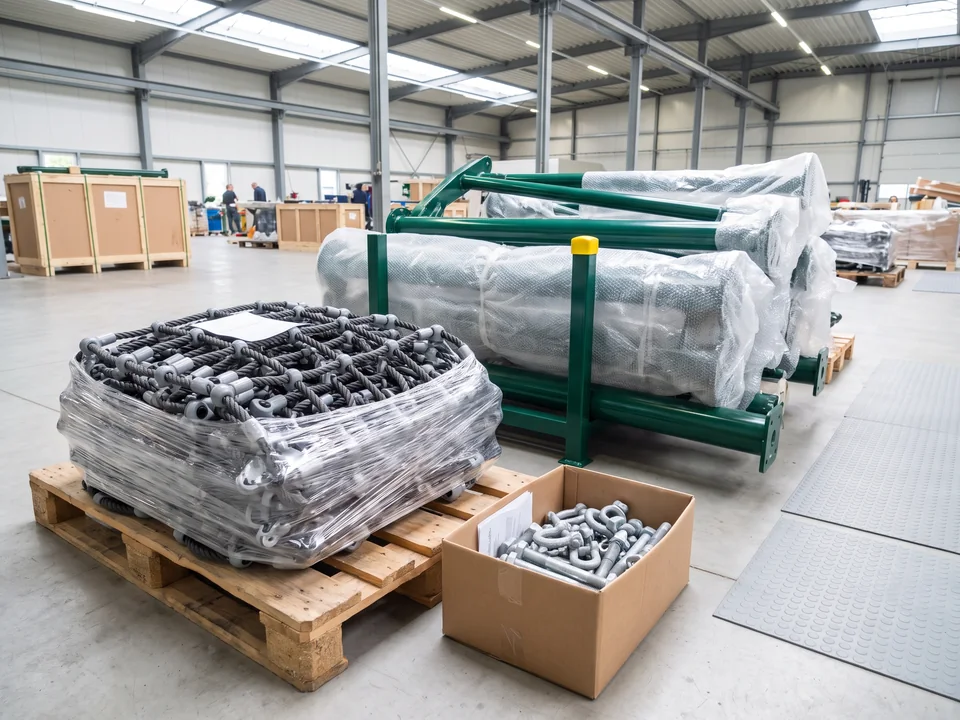
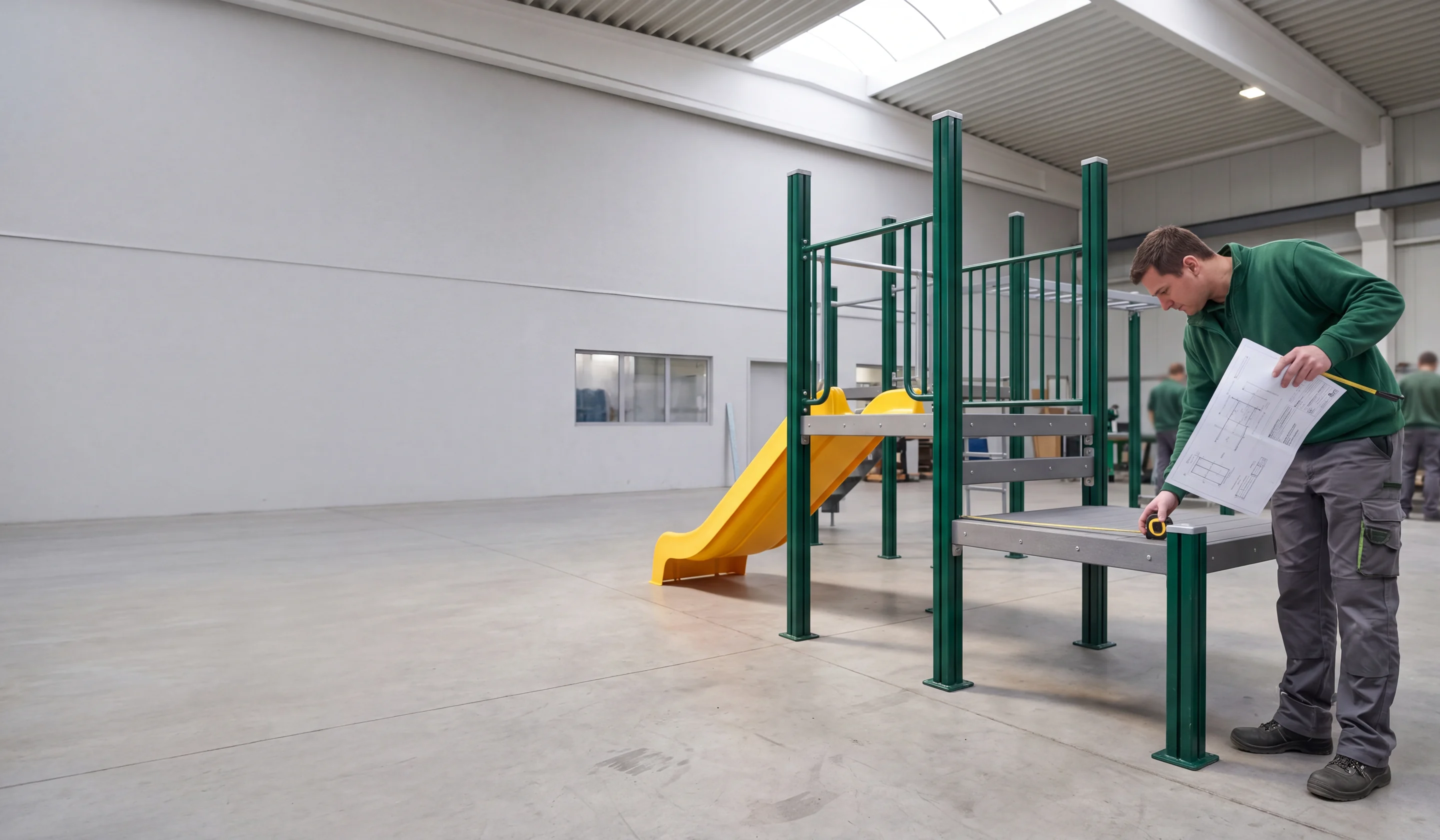
Space nets, climbing net frames, cargo nets and rope bridges in 16 mm steel-core polyester rope, made on our own rope line and tensioned in our yard before they are packed.
16 mm six-strand · steel wire core · UV-stabilized outer
Tension marked on every bolt and anchor
Mesh openings probed at factory tension
Every rope section numbered · replaced one at a time
Tag 01R1-012 · one sectionTag 02
02/ 135 forms · 1 rope line
Rope Play Equipment RangeSpace Nets, Climbing Net Frames, Structure Nets and Low Rope Walks
This rope playground equipment covers space nets on a single center mast, climbing net frames on Ø114 mm posts, cargo nets, vertical nets and rope bridges built into play structures, and low rope walks for 2–5 zones. Every net is made on our rope line from the same 16 mm steel-core rope.
They are built for parks departments, schools that need climbing for older grades and middle school, dealers, and installers fitting nets into a full outdoor order. Every net belongs to our commercial playground equipment line.
Rope line →
Space nets
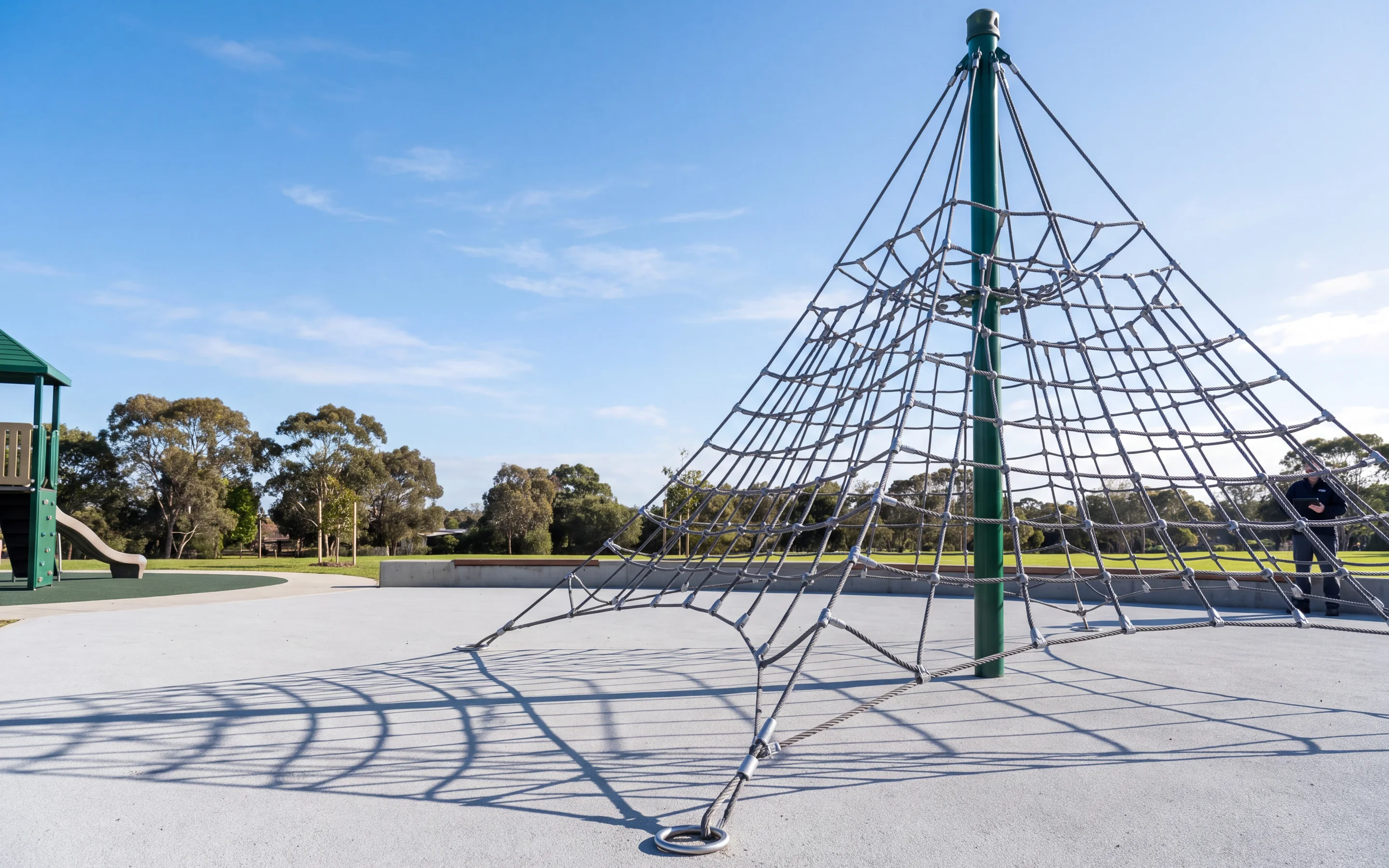
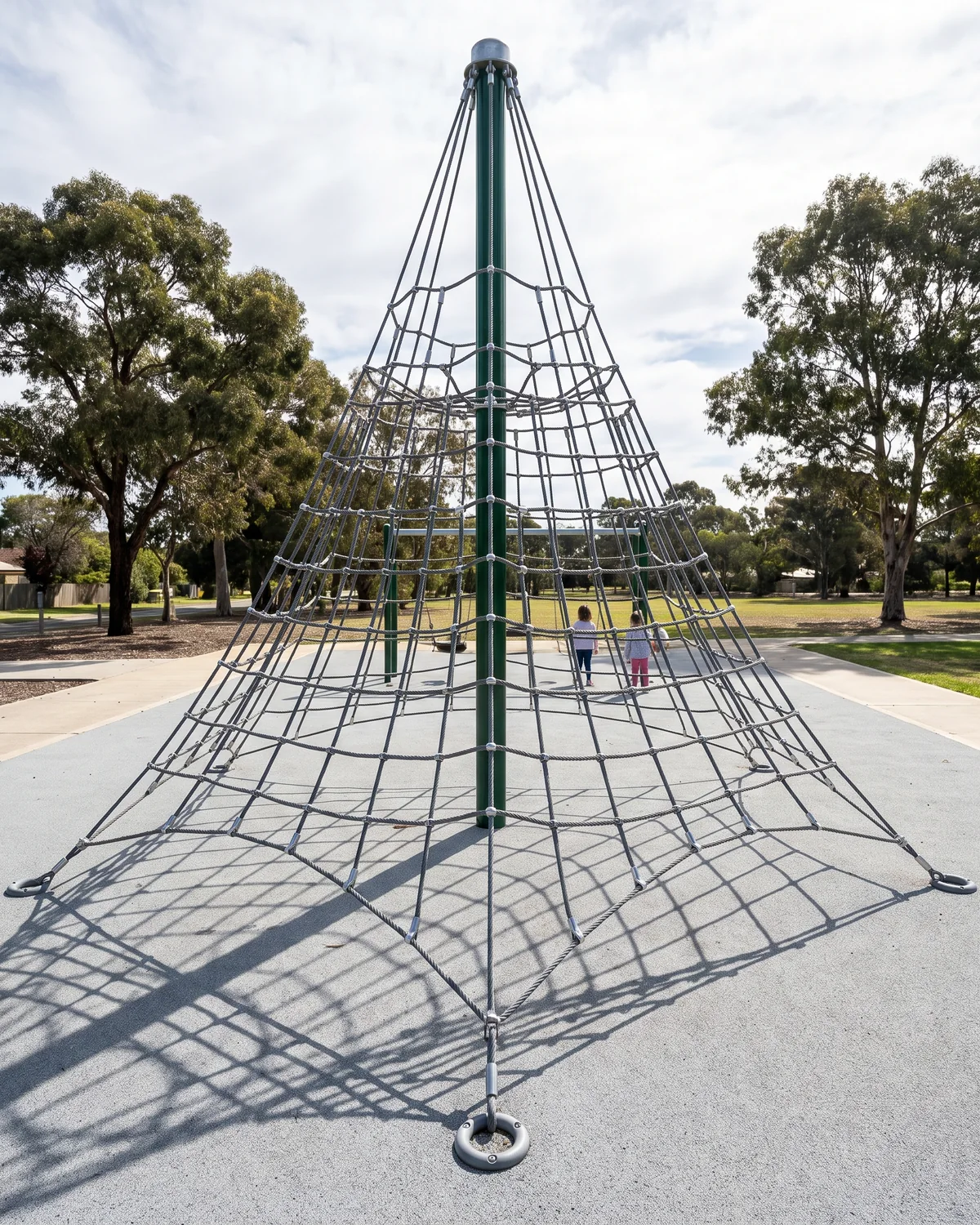
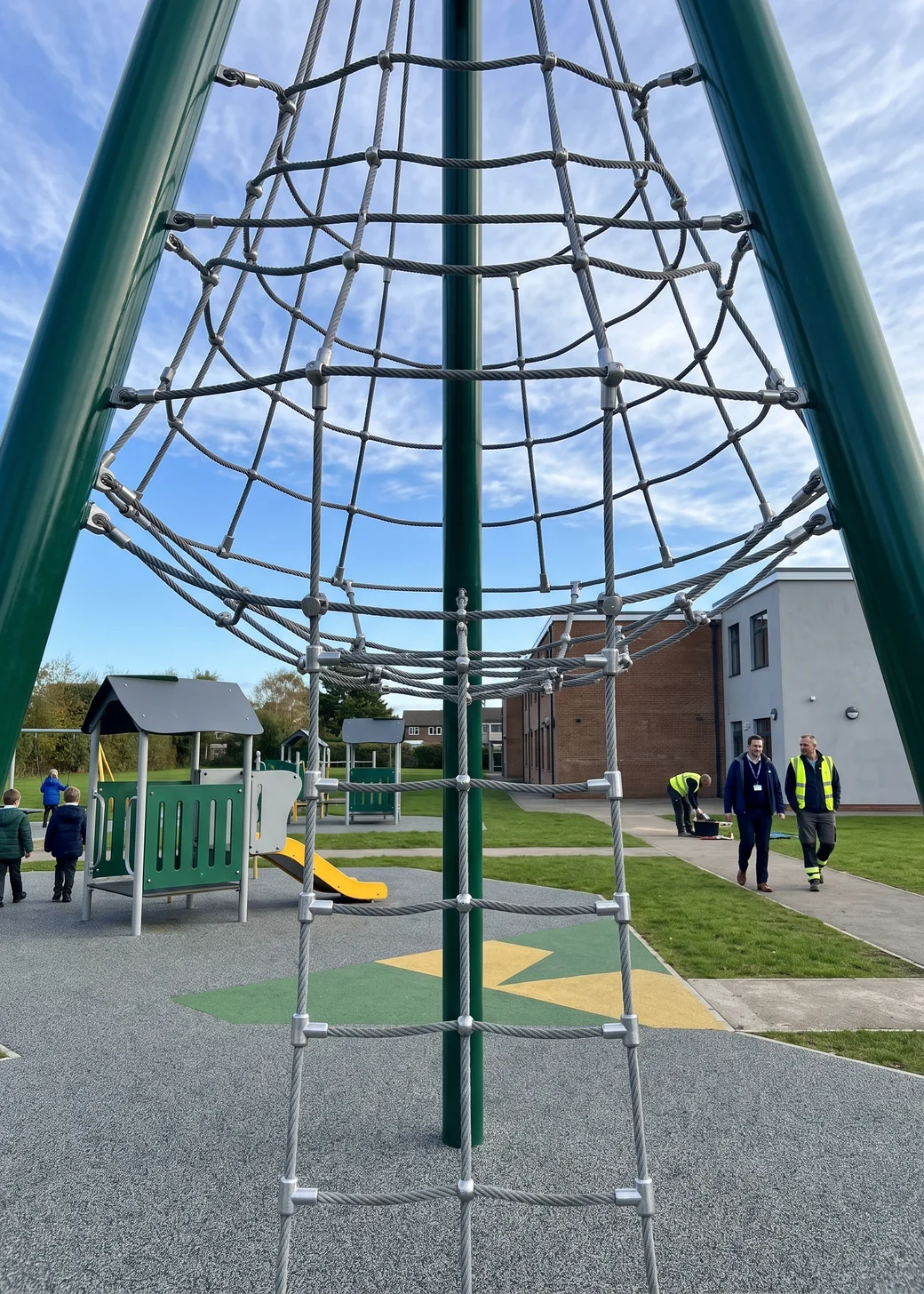
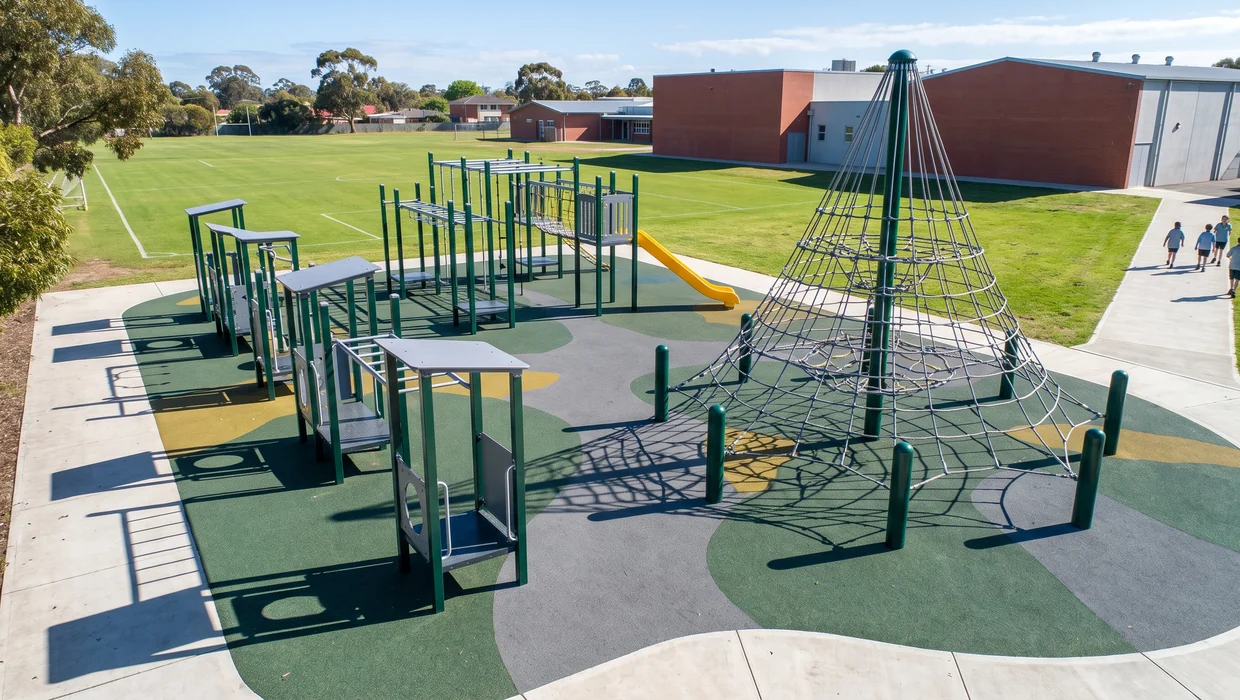
Pyramid and tower nets hung from a single center mast, climbed from every side. Freestanding.
Stands on · a single center mast
R1In-house
Climbing net frames
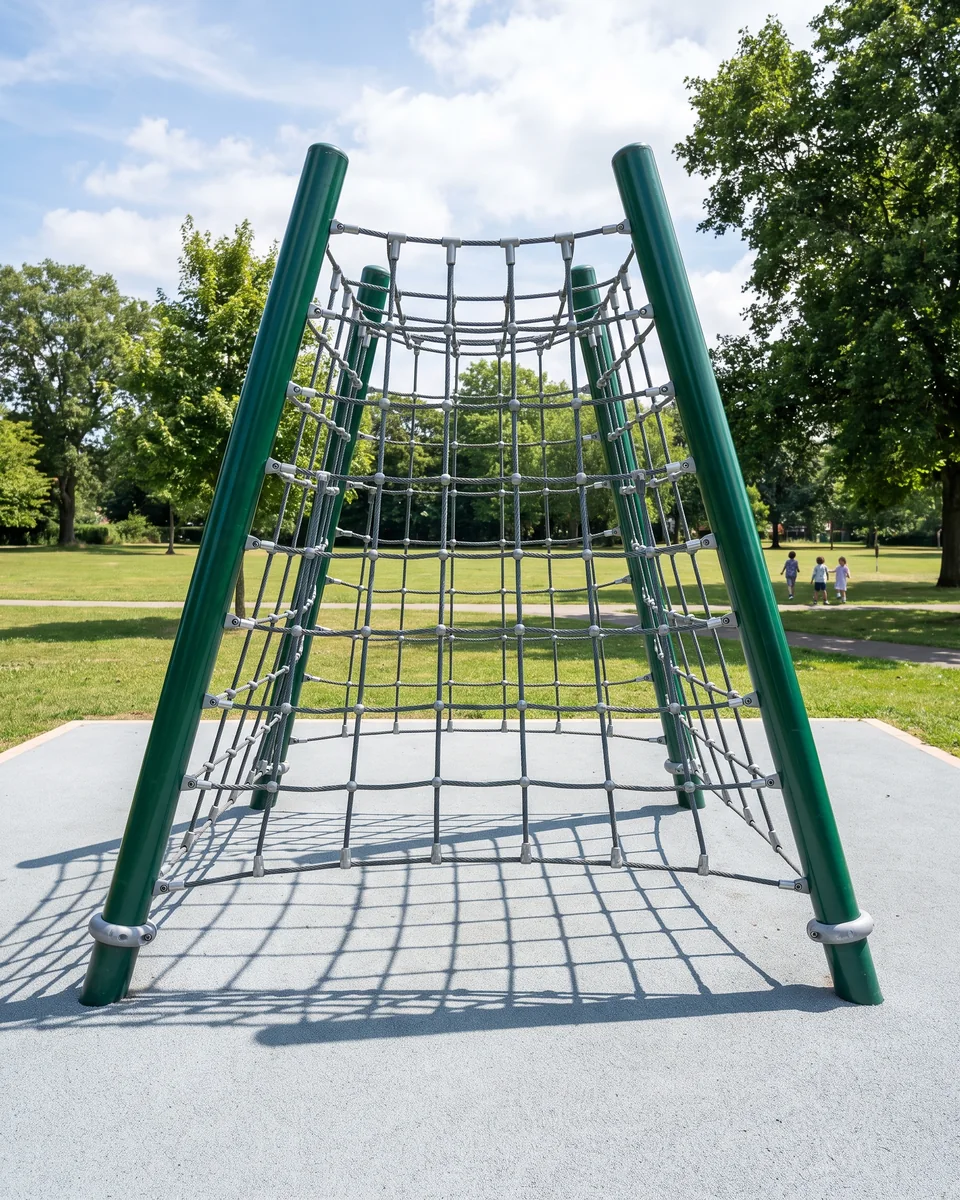
A-frame, arch and net-wall climbers, the net stretched between galvanized and powder-coated posts. Freestanding.
Stands on · Ø114 mm posts
RIn-house
Structure nets
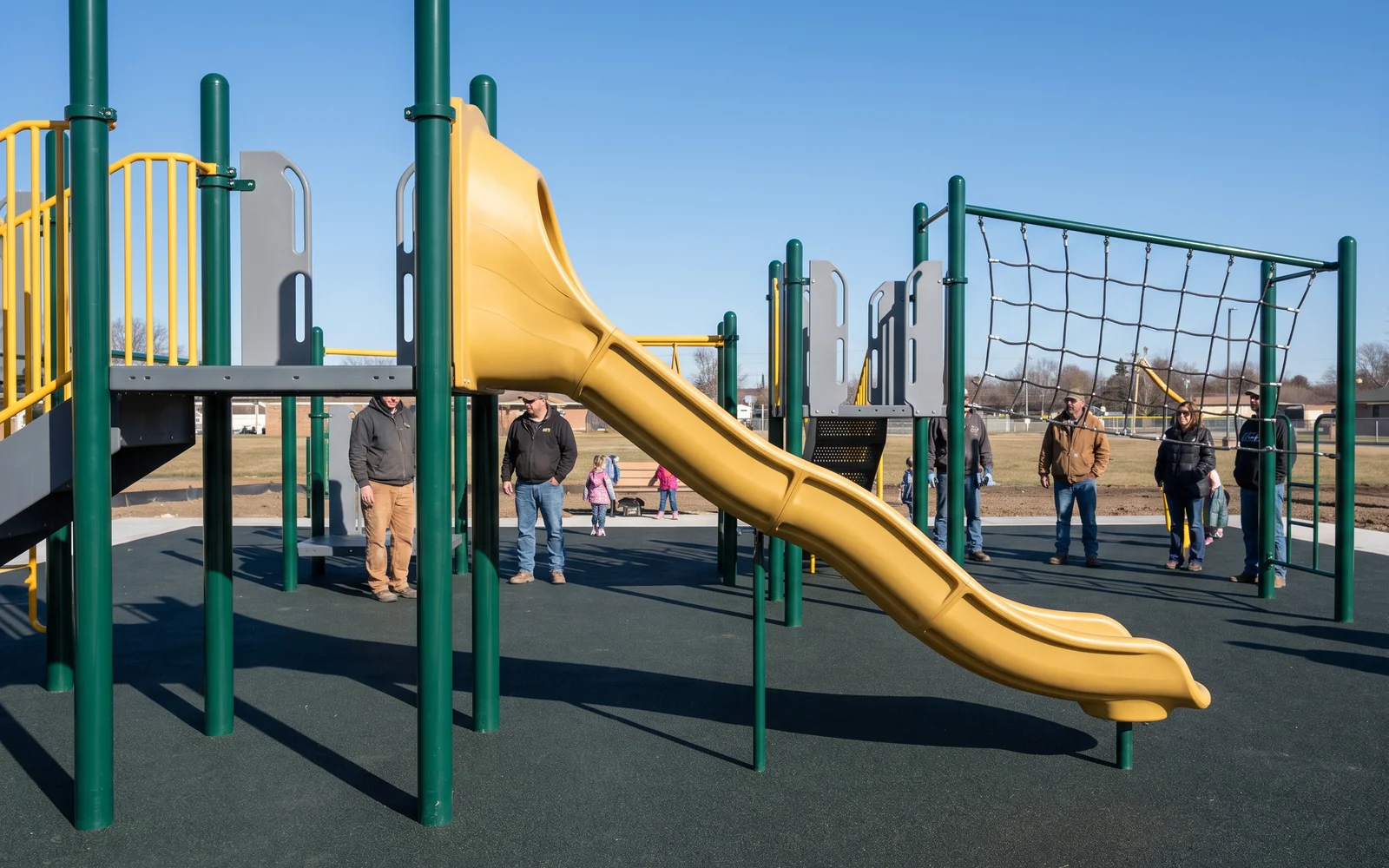
Vertical climbing nets, cargo nets, and rope and net bridges between decks, fitted as parts of a multi-deck play structure.
Stands on · structure posts and decks
S · of the structureIn-house
Low rope walks
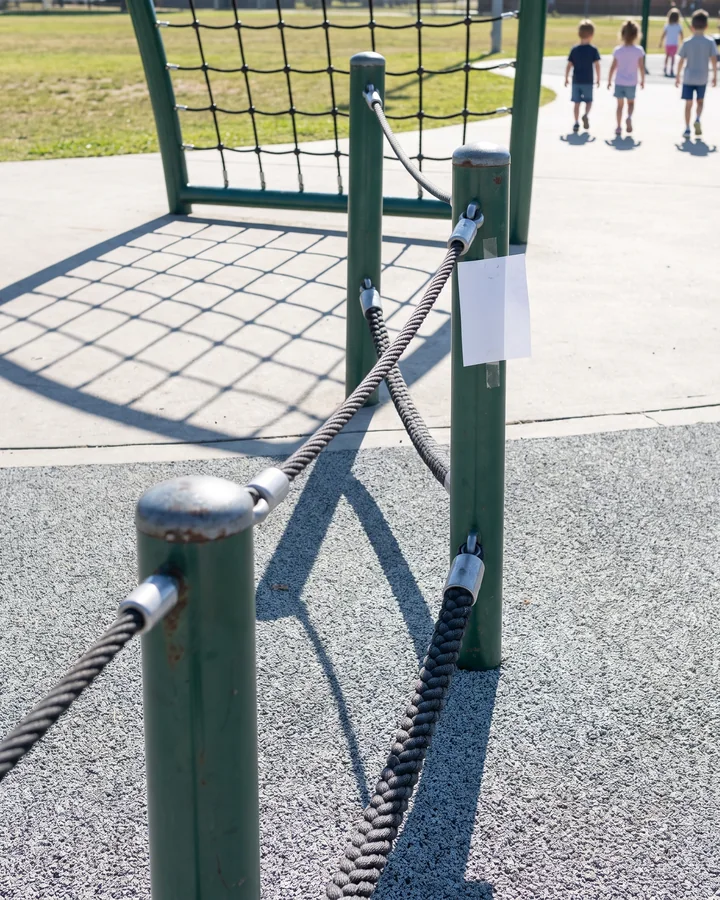
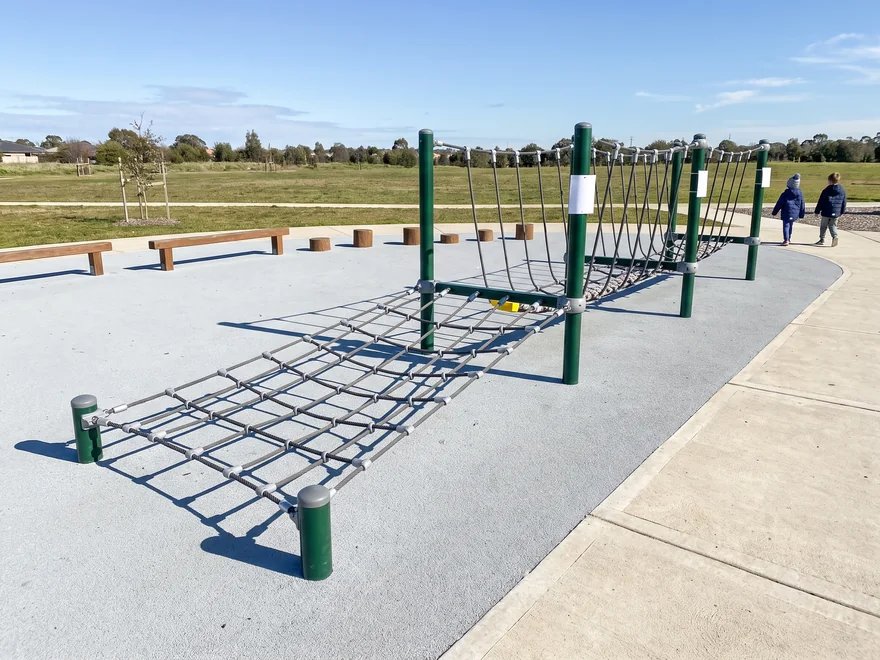
Rope traverses and walks at ground level for 2–5 zones.
Stands on · low posts
RIn-house
Nest swings
A net from the same rope line on a padded steel ring, on its own swing frame.
Each net sits on the same layout, footing drawings, quotation and container plan as your structures, slides, swings and surfacing.
03/ 13Who climbs it · where it stands
Climbing Net Selection by Age Zone2–5, 5–12 and Middle School
The net form is chosen by the age group that climbs it and the space it has on your site.
Nets are drawn to ASTM F1487 and the CPSC Public Playground Safety Handbook, or to EN 1176 where your project names it. Each net carries an age-range label.
2–5 zone
2–5 zones
Low nets and low rope walks at ground level. Children climb and balance close to the surfacing, and the nets are drawn into the 2–5 zone on your layout.
5–12 zone
5–12 zones
Space nets and tall climbing net frames. A space net gives a group many routes up a single net, and it is open on all sides, so a supervisor sees through it across the zone. Net frames and structure nets add climbing routes along a play structure.
Ages 11–14
Middle school
For ages 11–14, the upper 5–12 climbing and rope structures carry the climbing, alongside outdoor fitness stations and obstacle rigs. How a school yard is laid out by grade band is on school playground equipment.
Heights
Every net's height is on its item data sheet, and it sets the fall height and the surfacing under the net.
Standards
ASTM F1487 with the CPSC handbook, or EN 1176 where named. An age-range label on every net.
What you get
Each net appears on your layout with its form and structure number, plus a single-item plan and elevation that shows its use zone.
ItemR1
FormPyramid space net
Zone5–12
Use zonePer CPSC
04/ 13One rope section · seven parts
Rope and Net Specifications
Every net on this page is built from the same rope, connectors and hardware. Point at a row to find the part.
1 ferrule end · 2 rope · 3 aluminum connector · 4 nylon cross connector · 5 anchor ring · 6 tensioning bolt · 7 mast top
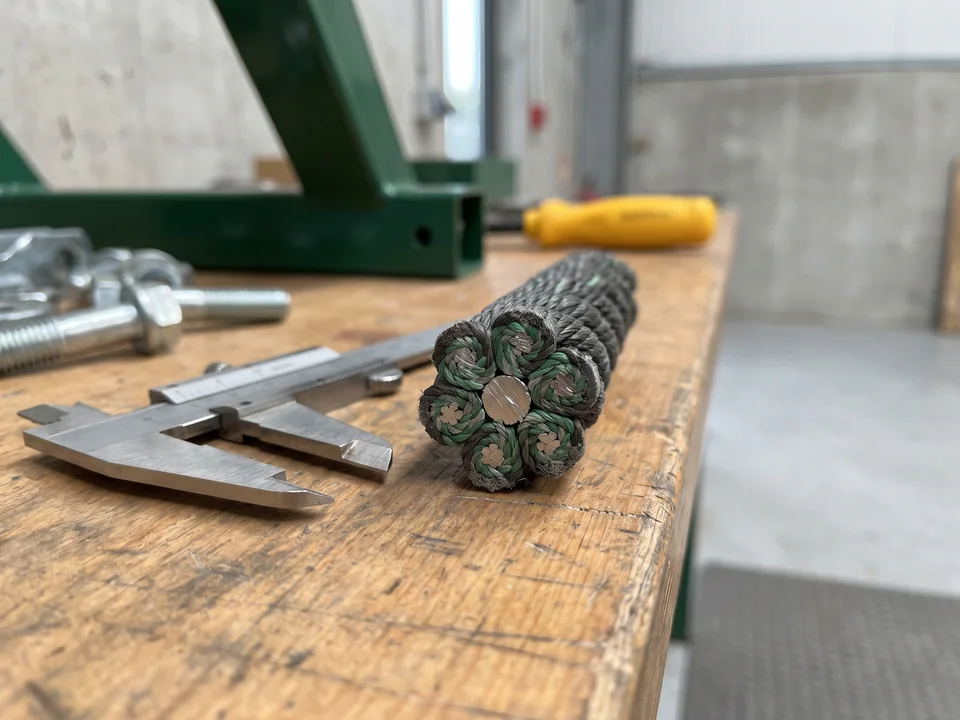
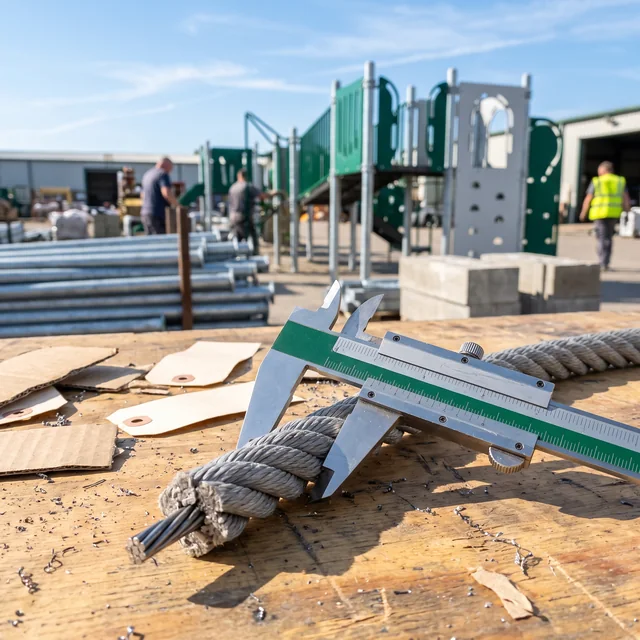
Every batch of rope is measured against 16 mm at our incoming check. The diameter is on your material spec sheet, so you can measure the net that arrives.
Rope and net specifications
Item
Part
Specification
Rope
2
16 mm six-strand polyester, , UV-stabilized polyester outer
Steel wire coreSteel wire at the center of the rope, with the six polyester strands laid around it.
Ground anchor rings, or tensioning bolts on a steel base frame
Mast fixing
7
In concrete by default, anchor-bolt base plate optional
Steel colors
—
RAL chart
Part numbers
—
R for freestanding rope structures (e.g. R1-012) · S for nets on a play structure
Warranty
—
Rope and nets 2 years · steel masts, posts and frames 10 years
05/ 13Cut · press · net · label
Rope and Connector Construction16 mm Steel-Core Rope, Pressed Aluminum and Bolted Nylon Connectors
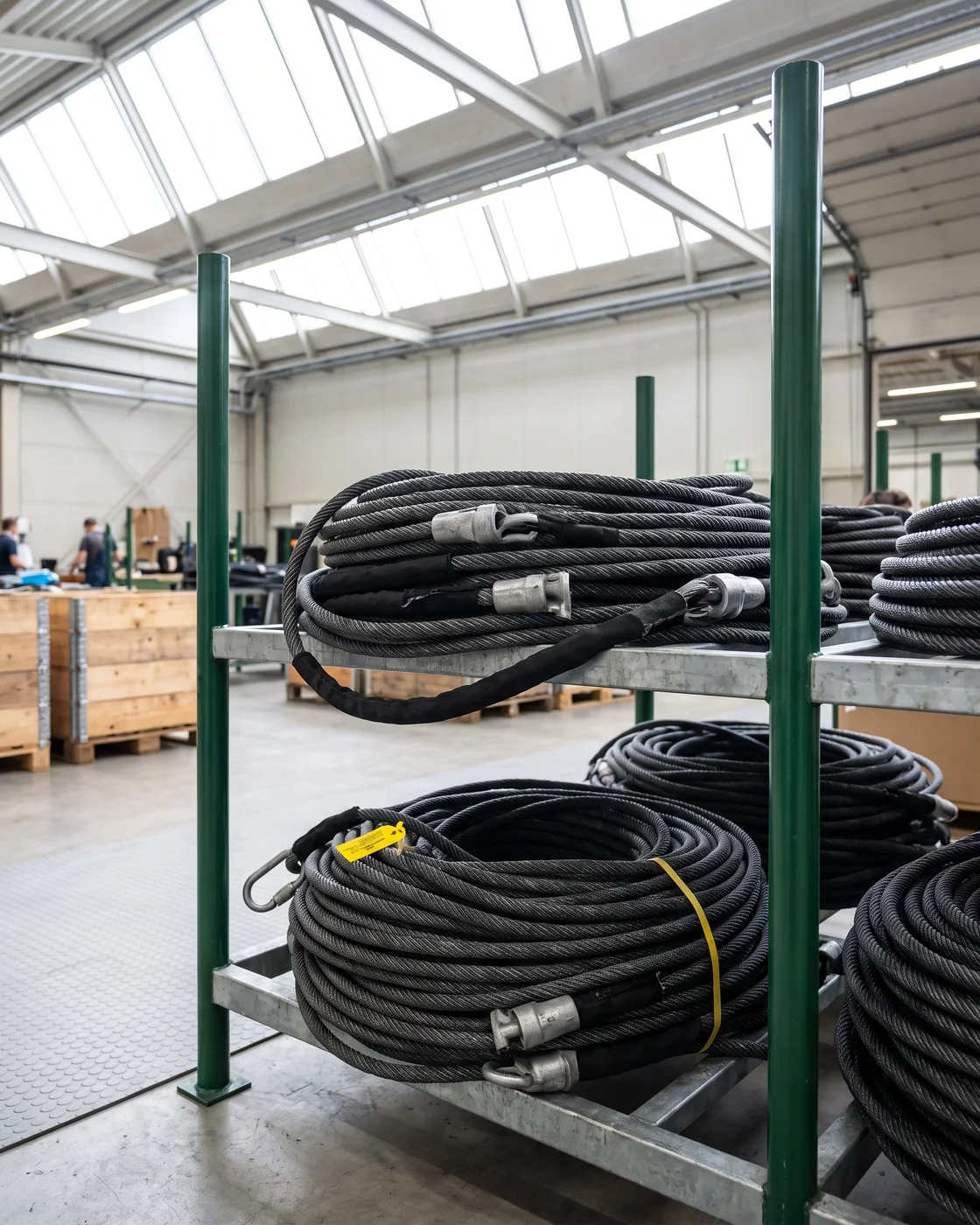
Six strands of polyester are laid around a steel wire core to a 16 mm diameter, and the polyester outer is UV-stabilized for playgrounds in full sun. The rope comes to us as raw material; the nets are made on our own rope line.
Each net starts as a net drawing from our design office that fixes its form, mesh openings, section lengths and section numbers. The rope line builds it to that drawing.
00
Incoming check
The diameter of every batch is measured against 16 mm. A batch that does not measure goes back to the supplier and never reaches the rope line.
01
Cut and heat-seal
The rope is cut to the section lengths on the net drawing and each cut end is heat-sealed.
02
Press
Aluminum connectors and ferrules are pressed on with a hydraulic press, one at a time, then pull-off spot checked.
03
Net on the table
The net is laid out on a netting table to the drawing, joined at its connectors and clamped at its crossings.
04
Label every section
Every section is labeled with its number before the net goes to the pre-assembly yard.
Aluminum connectors
Where two ropes join permanently, an aluminum connector is pressed onto them with a hydraulic press, one connector at a time.
Hydraulically pressed · pull-off spot checks
Nylon cross connectors
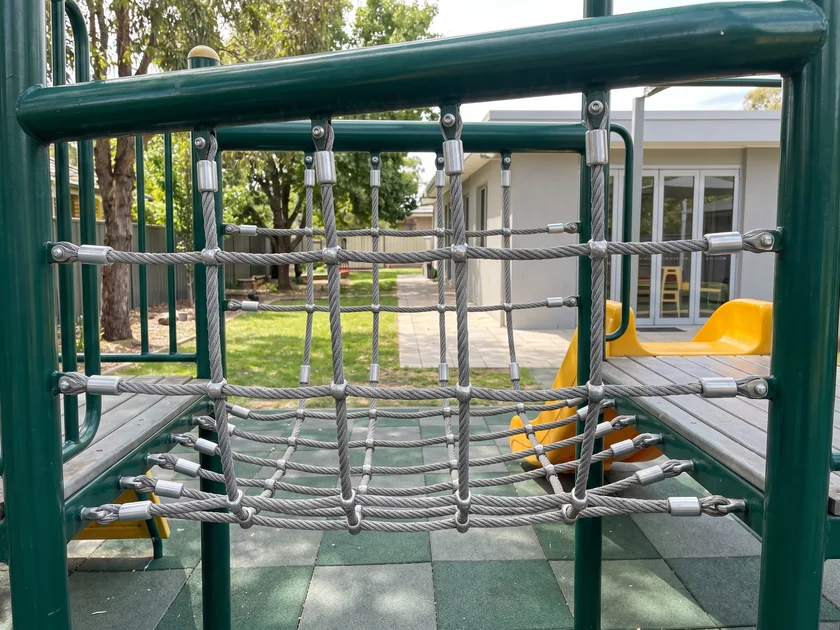
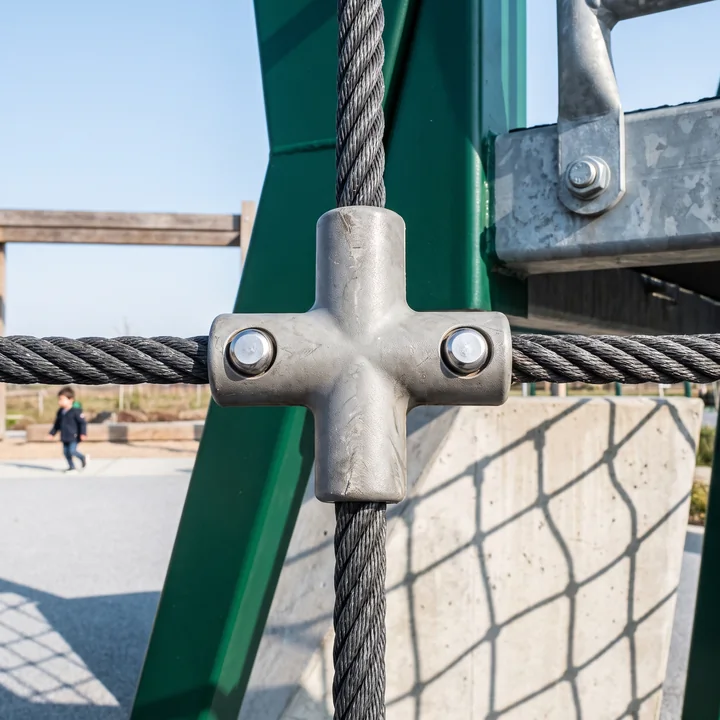
Where ropes cross, a clamps them and is bolted closed. The bolted connectors hold the mesh shape.
304 tamper-resistant · capped
Cross connectorA two-part nylon clamp that closes around two crossing ropes and is bolted shut, so the mesh keeps its drawn shape.
Rope ends
Each rope end is closed with a pressed aluminum and the polyester outer is heat-sealed, so the end does not fray where it meets an anchor ring, tensioning bolt or frame.
Pressed ferrule · outer heat-sealed
FerruleA short aluminum sleeve pressed over the rope end to close it.
Rope sections
A rope section runs from one connector to the next. That section is the unit we number and the unit you replace, and it is the reason every net on this page can be repaired one length at a time.
Samples
Ask for a rope-net section sample showing the rope, a pressed aluminum connector and a nylon cross connector in one piece.
16 mm steel-core ropetension marked at trial assemblyevery rope section numbered
R1-012 · marked · numbered · replaced one at a time
06/ 13Set in our yard · marked · matched on site
Space Net Masts and TensioningTension Set at Trial Assembly, Marked on Every Bolt and Anchor
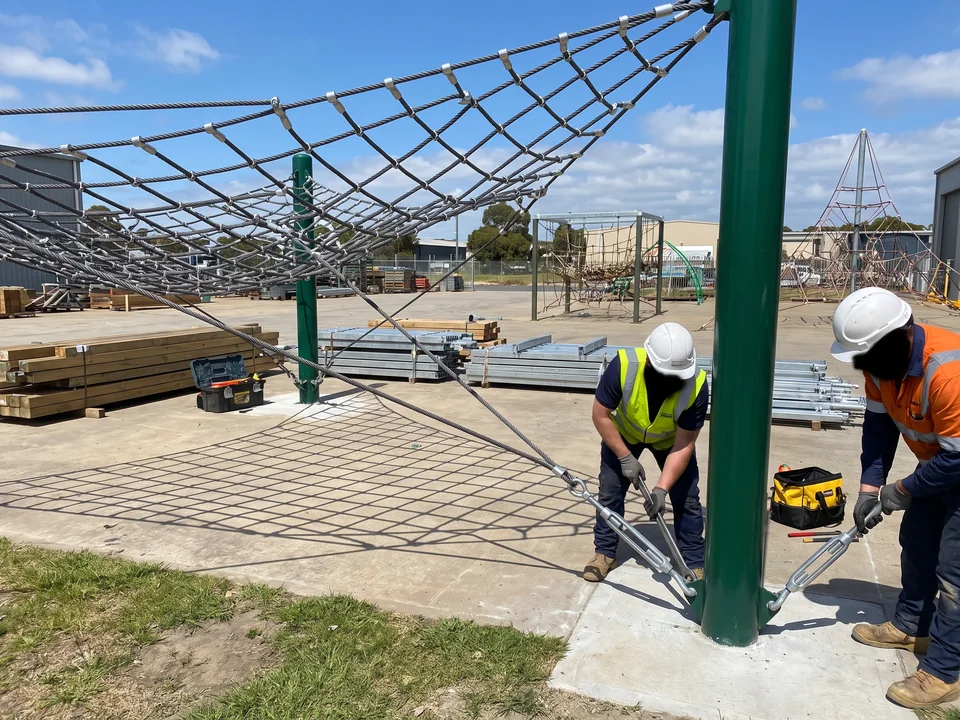
Each net's tension is set in our yard and marked at every point where it is adjusted, so your installer brings the net back to that tension on site. When the net is at its marks, it has the shape QC checked.
R1 space net · plan · scroll to tension, anchor by anchor
Slack · not yet at markAt mark · same shape as QC checked in our yardYard team · QCYour installer
ItemR1 space net
AnchorsTag 01–06
WhereOur yardYour site
RefTrial-assembly video
Plan of a six-sided space net on its center mast. Each face of the net starts slack and out of shape. As each tensioning bolt is turned to its colored mark and its anchor tag is checked, that face returns to the dashed factory shape recorded at trial assembly. Switching from our yard to your site changes only the ground: the marks and the tags stay the same.
The mast
The center mast is larger-diameter steel tube from our steel fabrication workshop, galvanized, then powder coated in the RAL color on your layout.
An anti-climb cap or top ring closes the mast top. By default the mast stands in concrete to our footing detail drawing, and an anchor-bolt base plate is available where you choose it.
Diameter on the item data sheet · anti-climb cap / top ring · in concrete or on a base plate
Anchoring the net
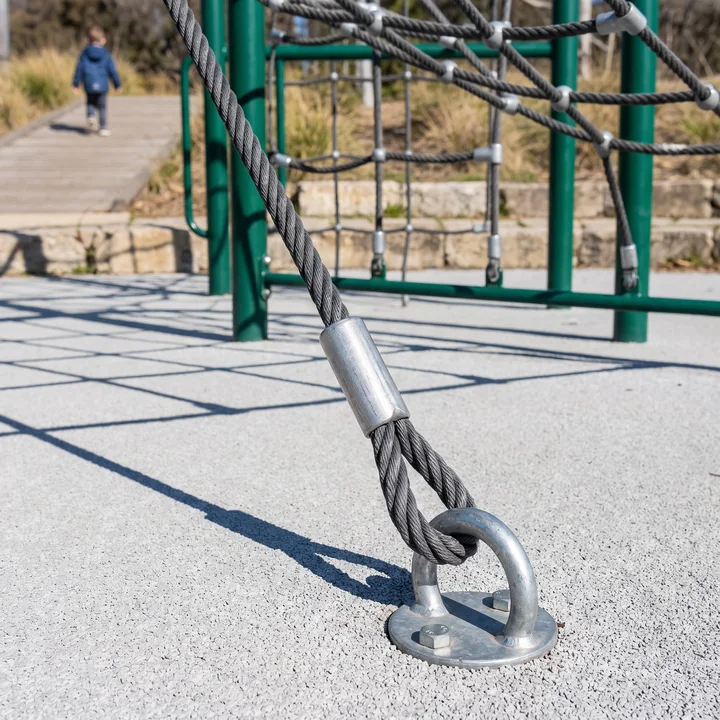
The top of the net hangs from the mast. Its bottom edges fix to ground anchor rings, or to tensioning bolts on a steel base frame. Net frames tension the same way between their Ø114 mm posts.
Ground anchor ringsBase frame · tensioning bolts
1
Hung and tensioned in our yard
Space nets and net frames are pre-assembled with the rest of your outdoor order. The yard team raises the mast, hangs the net and brings every edge to tension.
2
Checked at tension
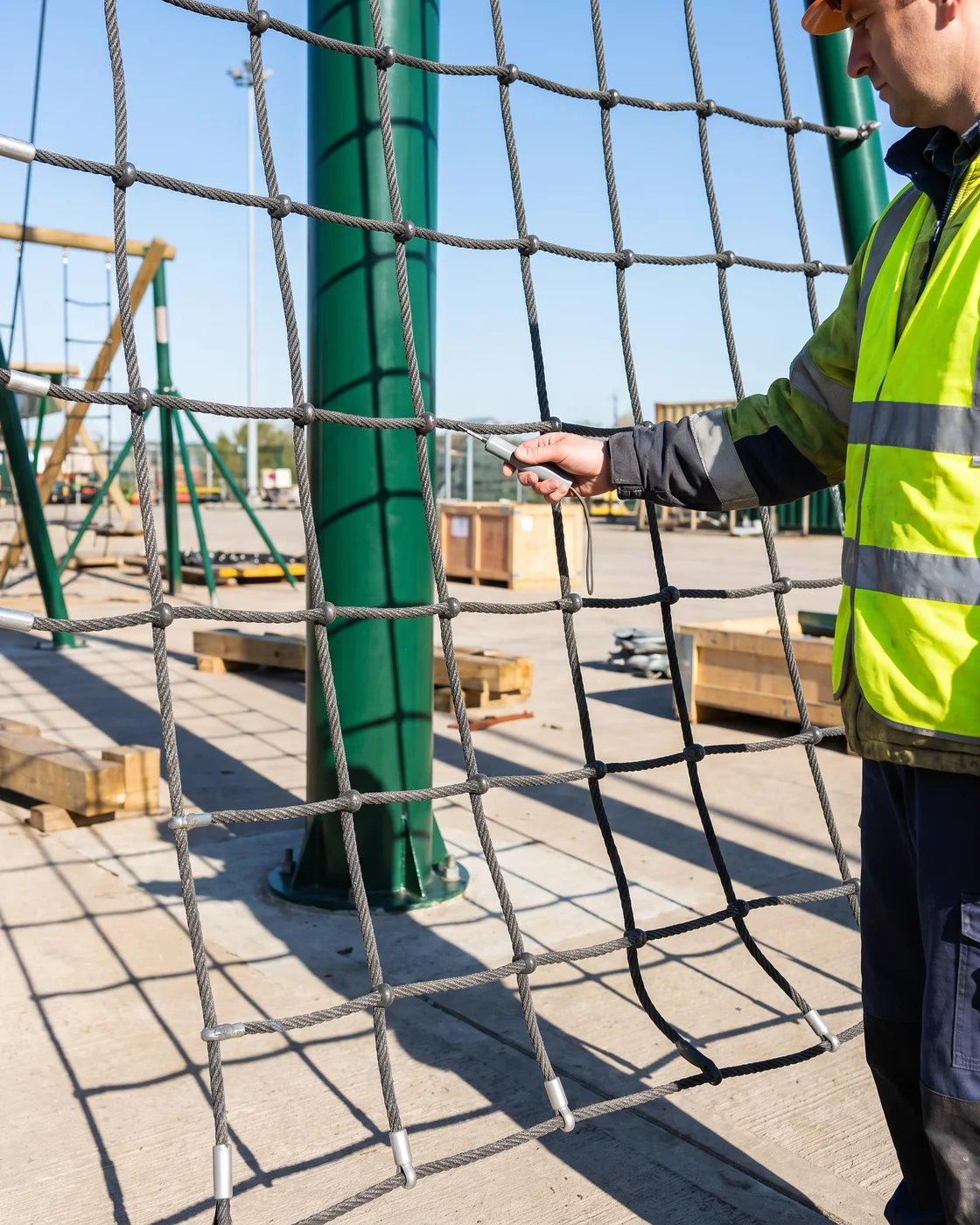
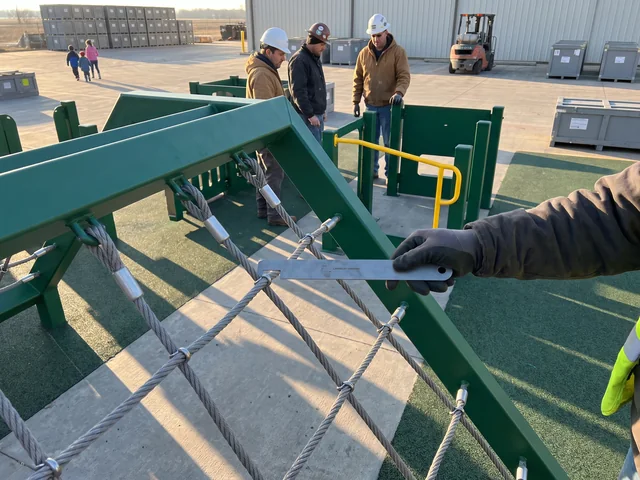
With the net held at tension, QC checks the mesh openings with entrapment probes and gap gauges, every pressed connector and the tension points. A net that fails a check is corrected in the factory and hung again.
Colored mark · numbered tag3
Marked
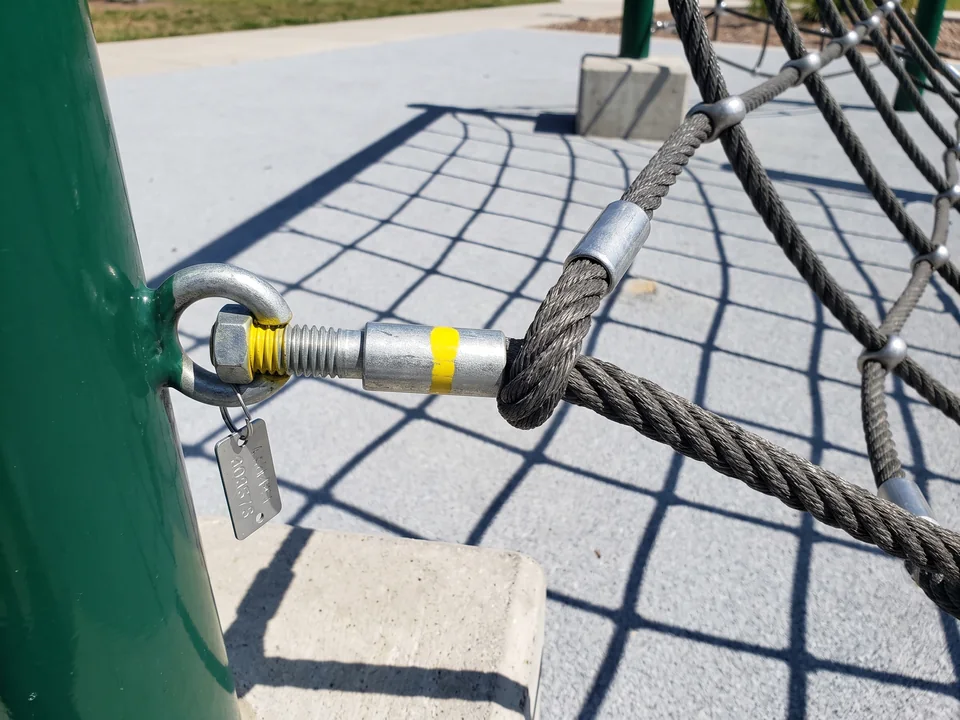
Each tensioning bolt gets a colored mark on its thread at the set position, and each anchor point a numbered tag. Both are filmed in the trial-assembly video with close views of the connectors and part numbers. QC signs off before the net comes down.
4
Shipped with its marks
The net is packed with its mast and anchoring hardware. The installation drawing shows each anchor number, and your installation video is cut from this net's own trial assembly.
On site
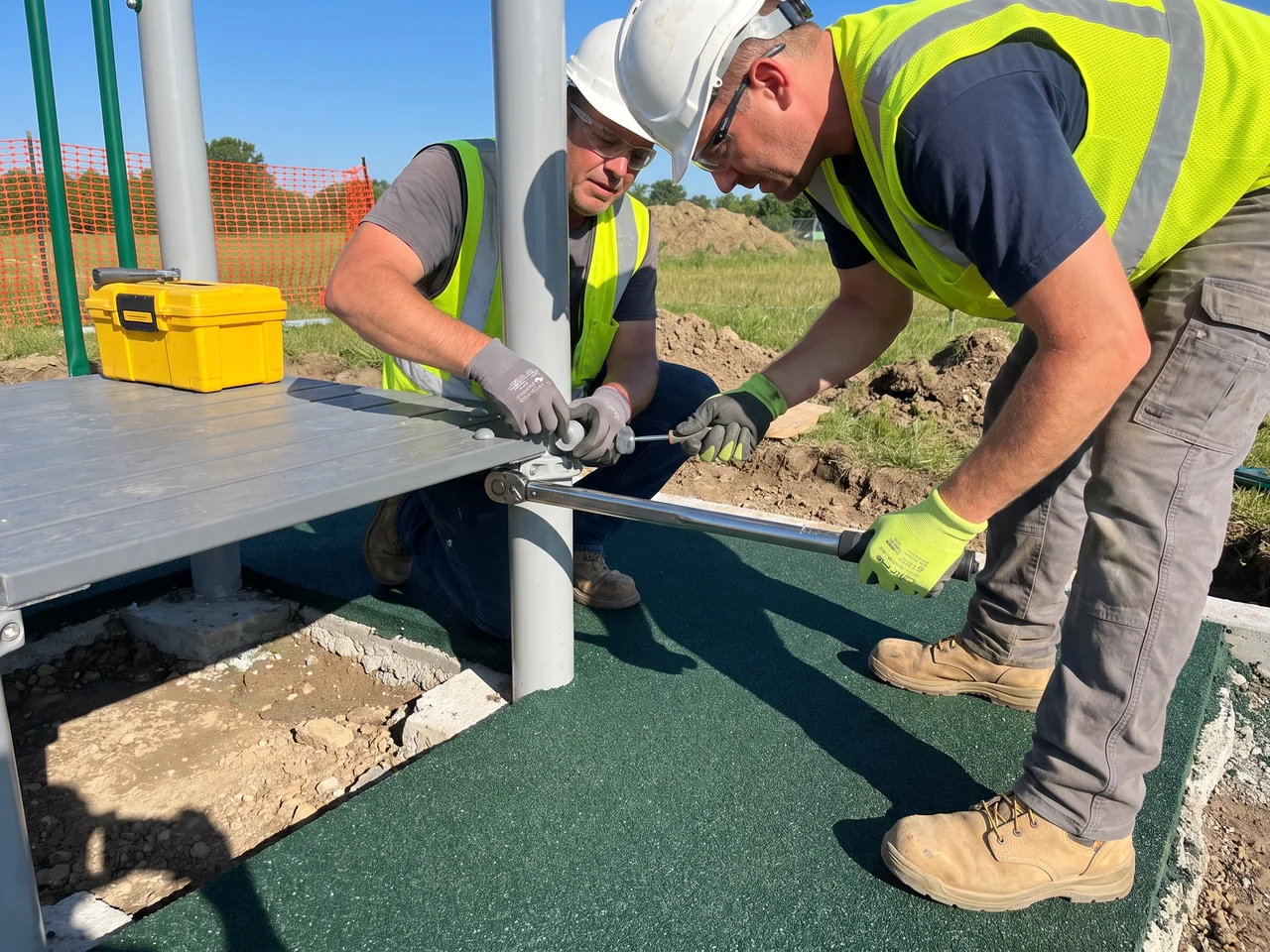
Your installer sets the mast, hangs the net and tightens each bolt to its colored mark, anchor by anchor, by tag number. The tension is re-checked after the first period of use, against the same marks.
If a bolt does not reach its mark, send photos and the anchor numbers and we book a WhatsApp video call to your installation hours with your project manager and the pre-assembly yard lead. More on playground equipment installation.
A net tensioned to marks has the same shape and mesh openings as the net QC checked in our yard.
Entrapment probe in a mesh opening · net held at its marked tension
07/ 13Checked at the marked tension
Mesh Openings and Entrapment ChecksProbes Under Factory Tension
Mesh openings are drawn to the CPSC handbook values for head and finger entrapment, or to EN 1176 where your project names it, and the rope line builds each net to that drawing.
QC check · R1 space net · pre-assembly yardAt trial assembly
Item
Check
Tool
Condition
Mesh openings
Head and finger entrapment
, gap gauges
Entrapment probeA test form sized to the handbook's head and finger values, pushed into an opening to show whether it can trap a child.
At marked tension
Pressed connectors
Every pressing
Visual, pull-off spot checks
After pressing
Ferrules
Protrusions, sharp edges
Hand check
At marked tension
Anchor rings
Protrusions, sharp edges
Hand check
At marked tension
Mast top
Cap or ring, sharp edges
Hand check
At marked tension
Cross connectors
Bolts and caps on every one
Visual
At marked tension
Why the check is made under tension
A rope net changes shape as it is tensioned. The openings are checked with entrapment probes and gap gauges while the net is at the tension marked on its bolts. The marks let your installer bring the net back to that tension, so the openings on site are the openings we checked.
Slack · shape changesAt the mark · checked
Nets on decks · your documents
Where a net or rope bridge meets a deck, the protective barriers and guardrails at that deck follow the handbook for the deck height and the age zone, as on the rest of the structure.
Your documents. Each quotation lists a design compliance statement per net for the standard you name, together with the material spec sheet and installation drawings with use zones. Third-party testing is arranged per project on request. How ASTM F1487, the CPSC handbook and EN 1176 apply across the whole playground is on playground safety standards.
Design compliance statement per net
Material spec sheet
Installation drawings with use zones
08/ 13Highest climbable point
Fall Height, Use Zone and Surfacing Under Climbing Nets
The of a net is taken at its highest climbable point. On a space net that is the upper part of the net near the mast top. On a net frame it is the top rope. On a structure net it is the deck the net climbs to.
Fall heightThe vertical distance from the highest point a child can climb to, down to the surfacing below. It sets the surfacing thickness and the use zone.
R1 · space net · upper net near the mast topR2 · net frame · top ropeS2 · structure net · the deck it climbs to
Use zone
Every net's is drawn around it on your layout to the CPSC handbook values for its height, or to EN 1176 where named. The layout runs a clash check, so a net's use zone does not overlap a swing separation zone, a slide exit or a spinner.
Use zoneThe surfaced area around a piece of equipment that must stay clear of other equipment, drawn to the standard's values for its height.
Surfacing
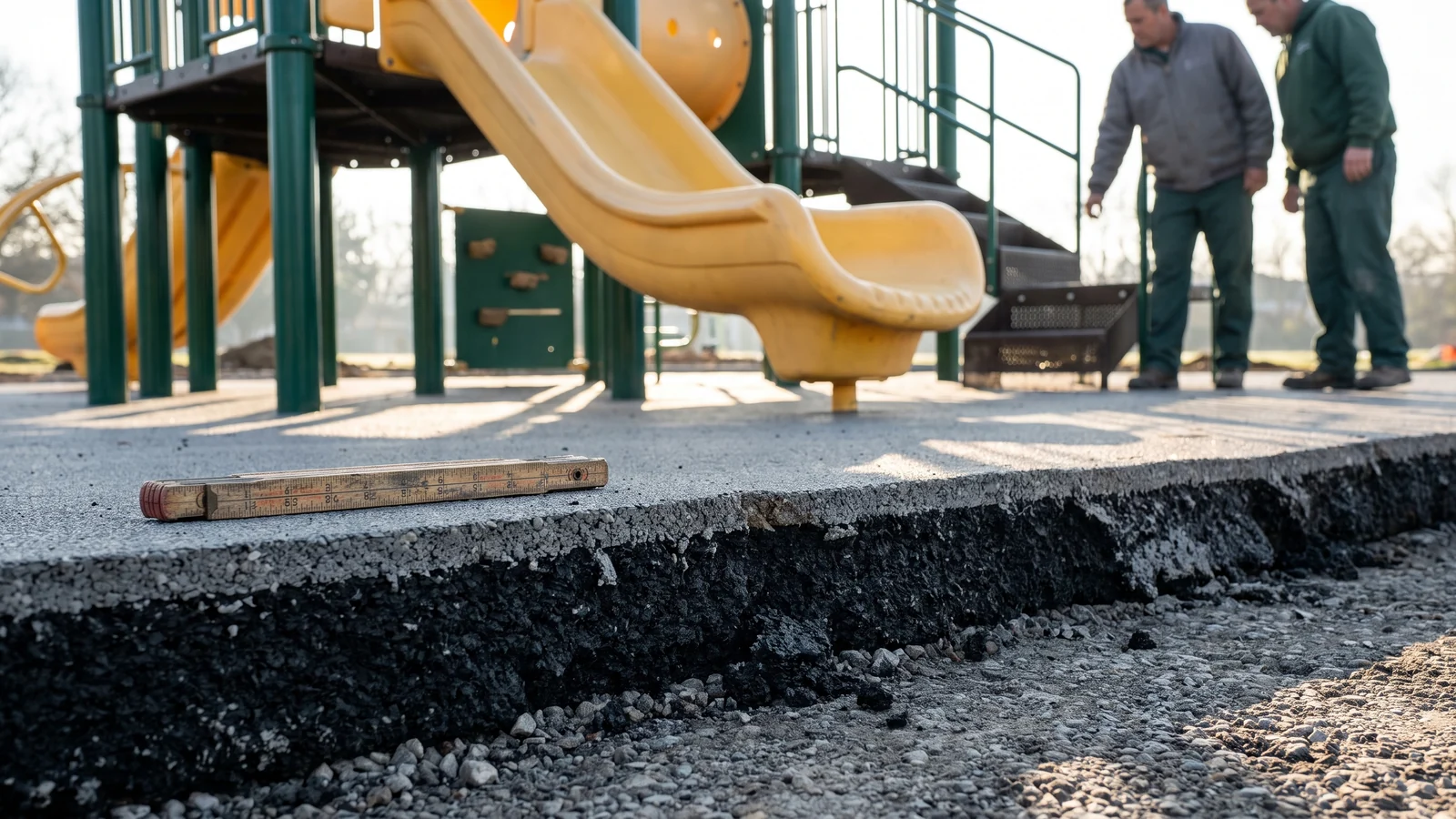
Surfacing thickness is chosen by the critical fall height of the net it sits under. Rubber tiles and poured-in-place EPDM come from our surfacing partner, to ASTM F1292 or EN 1177, and the partner's critical-fall-height data is included with your compliance documents.
P1 · under R1 · poured EPDM · area on your layout
The surfacing area table on your layout lists the area under each net by surfacing type. Options are on playground surfacing.
Footings
Mast footings, anchor rings and base frames are on the footing detail drawing, placed by your contractor before the surfacing goes down.
09/ 134 forms · 6 questions
Climbing Net ComparisonSpace Net, Net Frame, Structure Net and Low Rope Walk
Comparison of space nets, climbing net frames, structure nets and low rope walks
Space net
Climbing net frame
Structure net
Low rope walk
Form
Pyramid or tower net on one center mast
Net between posts: A-frame, arch, net wall
Vertical net, cargo net, rope or net bridge
Rope traverse at ground level
Age zone
5–12, middle school
5–12, middle school
Age zone of the structureFollows the structure
2–5
Stands on
Center mast plus anchor rings or base frame
Ø114 mm posts
Play structure posts and decks
Low posts
Tension marks
Every bolt and anchor
Every bolt and anchor
At the net's tensioning points
Set at trial assembly
Part numbers
R
R
S of the structure
R
Best for
A group climbing one net, open sightlines
Climbing along a path or zone edge
Routes up to and between decks
First climbing and balance
Indoor soft play uses a different net: knotless fire-retardant netting stitched in our sewing workshop, as spider nets and net bridges on an indoor frame. See soft play equipment.
Send the site plan and the age zones, and tell us which net forms you want.
Nets on Multi-Deck Play StructuresCargo Nets, Vertical Nets and Rope Bridges
On a multi-deck play structure the nets are the climbing routes up to the decks and the crossings between them.
Structure nets fix to the same Ø114 mm posts and deck frames as the rest of the structure, with 304 stainless steel tamper-resistant fasteners.
S2 · elevation · three nets, one structure
ItemS2
NetsVertical · cargo · bridge
PrefixS
SheetElevation
Elevation of a two-deck play structure: a vertical climbing net hung from the lower deck edge, a cargo net from the ground up to the upper deck, and a rope bridge between two decks. One rope section in each net is numbered under the structure's S prefix.
Vertical climbing nets
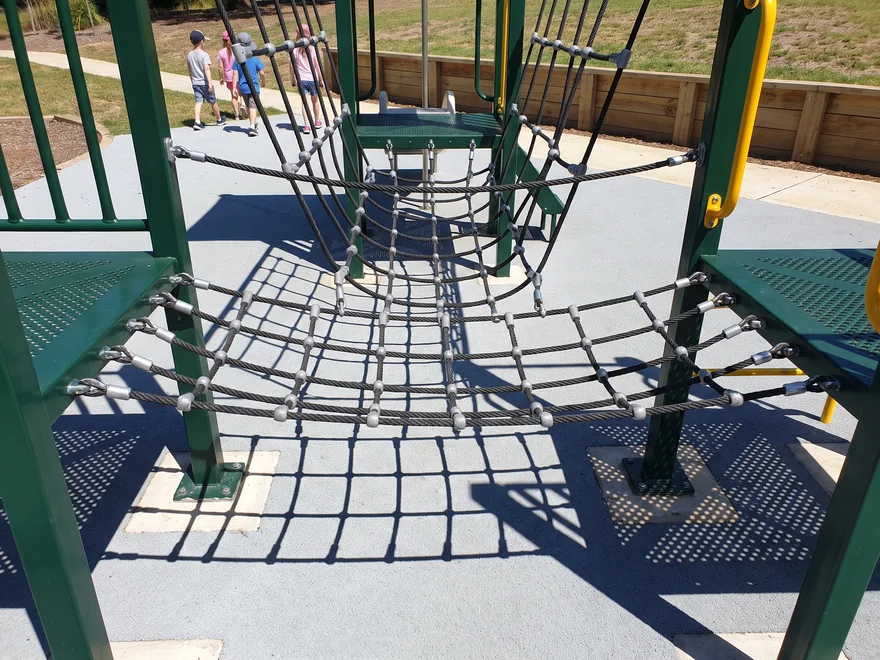
Hung from a deck edge and anchored at the base, a climb up to the deck.
Cargo nets
Set at an angle between the ground and a deck, climbed on hands and feet.
Rope bridges and net bridges
Spanning two decks, fixed along both sides and walked across.
Part numbers
Each rope section is numbered under the structure's S prefix, such as S2-021, and listed on the same part list and packing list as the posts, decks and panels around it. The nets are hung, tensioned and checked when the structure is pre-assembled, and filmed in the same trial-assembly video.
Deck entries
Where a net bridge or cargo net meets a deck, the net, the deck entry and its barriers are drawn on one elevation. How posts, decks, panels and fasteners come together is on commercial playground equipment.
Same part list · same packing list · same trial-assembly video
11/ 13One section · one number · mast stays
Rope Section ReplacementNumbered Sections Reordered by R Part Number
Rope is the part of a net that wears. Every net is built so that you replace only the length that wore: order that section by its number and fit it at its connectors, with the mast left in place.
SectionR1-010R1-011R1-012R1-013R1-014R1-015
From connector to connector
Original length · original connectors
Same 16 mm steel-core rope
Rope color from your project file
Same number on net drawing · installation drawing · packing list
A rope section runs from one connector to the next. On our rope line each section is labeled with its number as the net is built, and the same number is on the net drawing, the installation drawing and your packing list — R1-012 on a freestanding space net, S2-021 on a structure net.
What you send
A photo of the worn section and its number.
What we do
QC confirms the number against your project part list. The rope line makes a new section to the original length, with the original connectors, from the same rope, in the rope color recorded in your project file.
Reply within 24 hours on business days · air courier
How it is fitted
The crew removes the worn section at its old connectors and fits the new one in the same place. The mast stays, the rest of the net stays hung, and nothing under the surfacing is touched.
Security bits for the tamper-resistant fasteners are in the spare kit that ships with your order; after the swap, each tensioning bolt is checked against its colored mark.
If the crew gets stuck
Send photos and part numbers, and we set up a WhatsApp video call during your working hours.
2years
Rope and nets
10years
Steel masts, posts and frames
For dealers
Replacement sections for your clients are ordered through you, by part number, outside any main order, and go by air courier. More on wholesale playground equipment.
Rope colors · standard range, custom on request
12/ 13Recorded in your project file
Climbing Net OptionsRope Colors, Mast Colors and Dealer Branding
Rope colors
A standard color range, with custom colors on request. The rope color of each net is recorded in your project file.Color recorded → replacement sections match
Connectors
Aluminum and nylon connectors in fixed colors.
Fixed colors
Masts, posts, frames
Powder coated in colors from the RAL chart, matched to the play structures on the same layout.
Fixing
Mast in concrete or on an anchor-bolt base plate; net edges to ground anchor rings or a steel base frame with tensioning bolts.
Concrete · base plate · rings · base frame
Dealer branding
Your logo on signage beside the net, net layouts and data sheets under your brand or with no brand, and the manufacturer label under your brand on OEM orders. More on wholesale.Our part numbers stay on every rope section
13/ 13Nine items · one message
What to Send for a Climbing Net Quotation
Climbing net quotation · checklist
A dimensioned site plan, or your current playground plan with the net position marked
Age zones for the nets: 2–5, 5–12, middle school
Net forms you want: space net, climbing net frame, structure nets on a play structure, low rope walk
Space available around each net position, and the structures, swings and paths near it
Whether the ground can take mast footings in concrete, or needs a base plate or base frame
The surfacing you have or plan under the nets
Your required standard: ASTM F1487 with the CPSC handbook, or EN 1176
Rope colors, and RAL colors for masts, posts and frames
For replacement sections: a photo and the section number from the label or your packing list R1-012
Send to Anna · WhatsApp +86 177 0272 7677 · or the form below
 00
00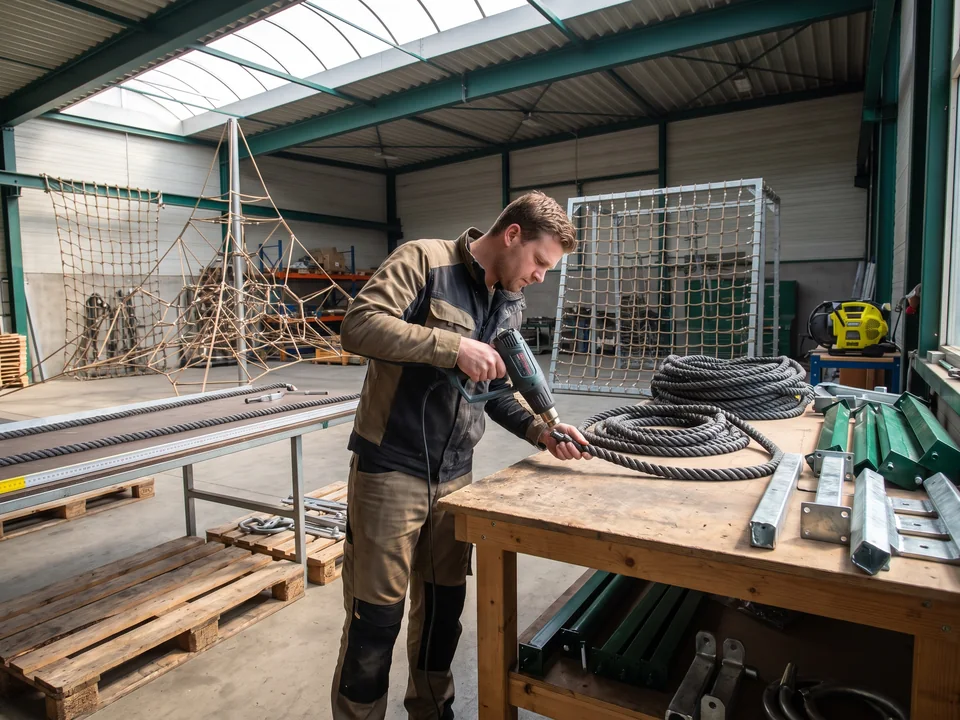 01
01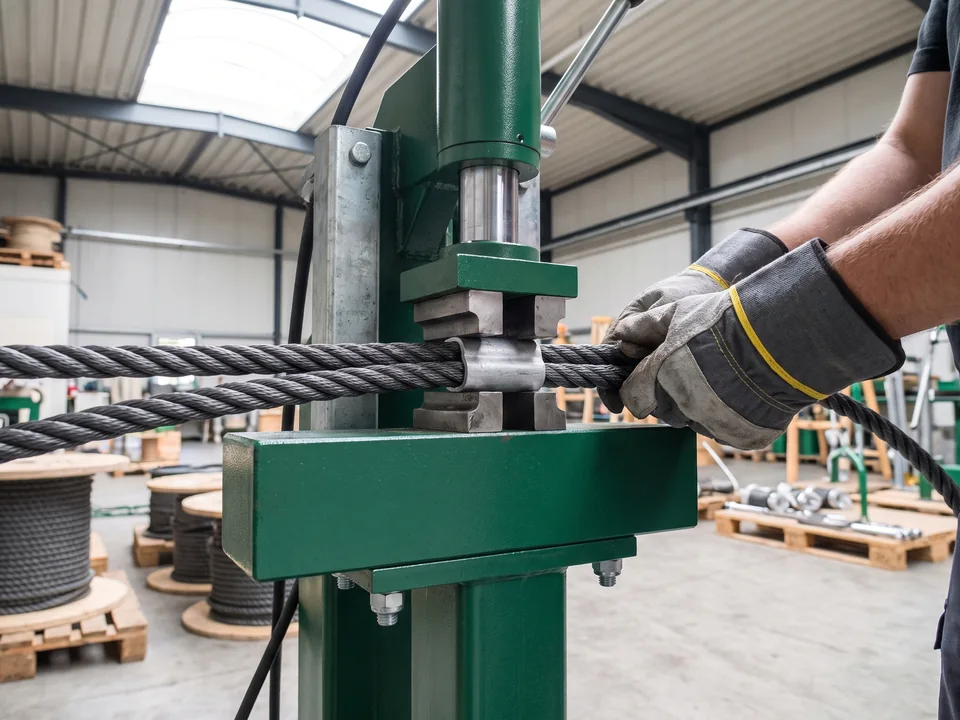 02
02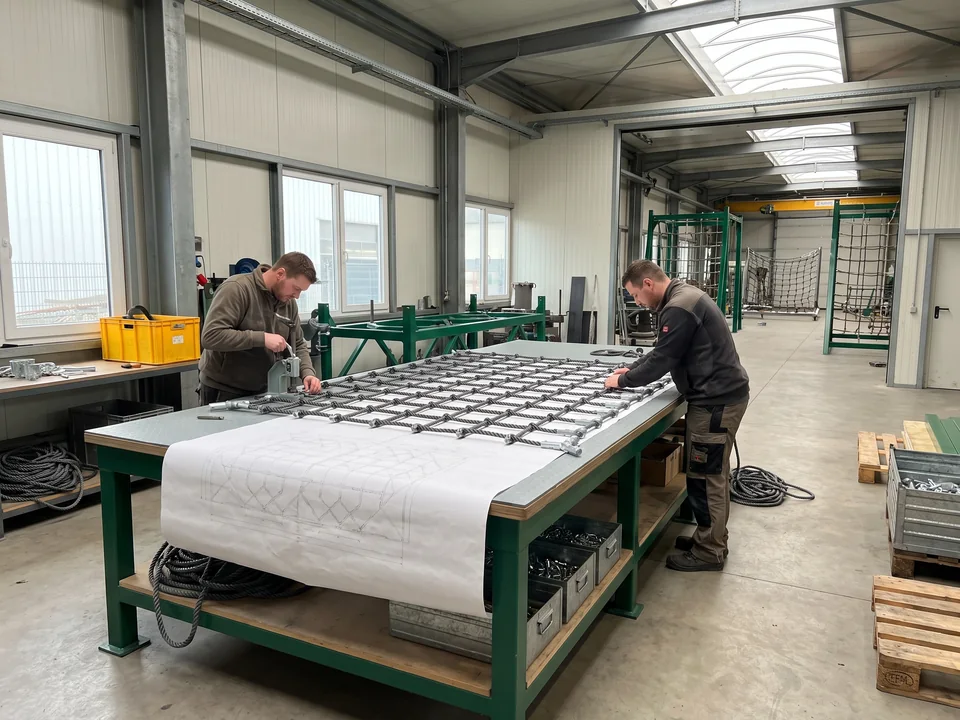 03
03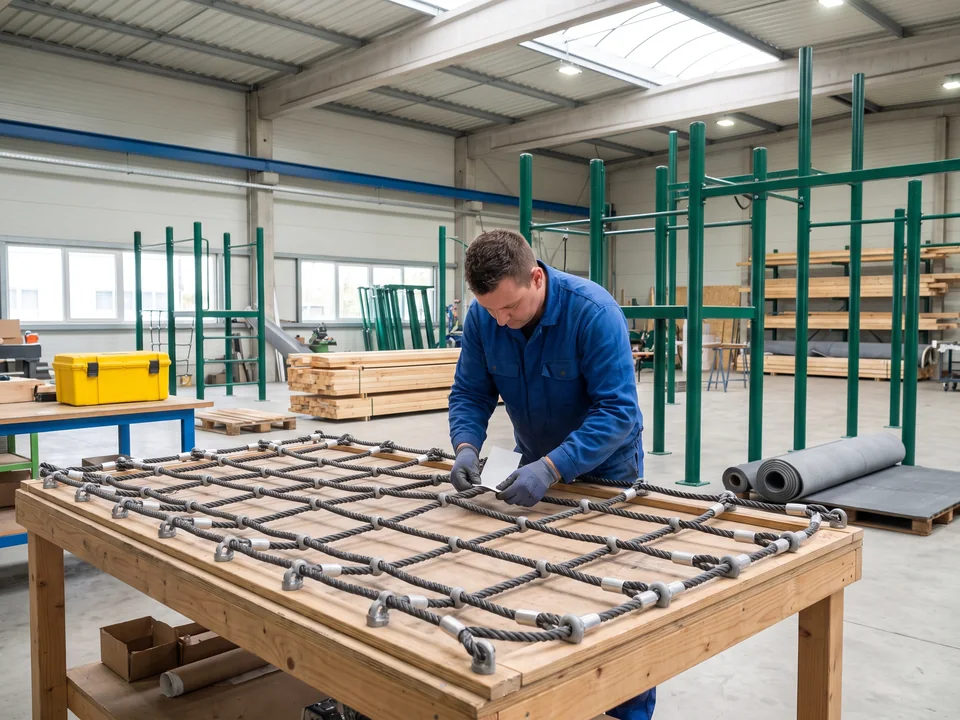 04
04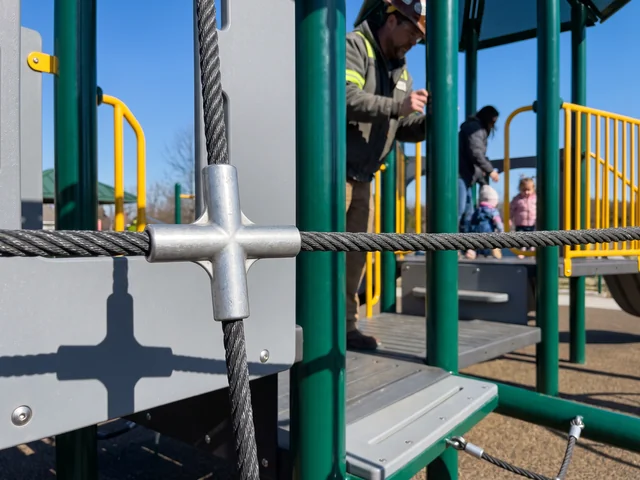
 Colored mark · numbered tag