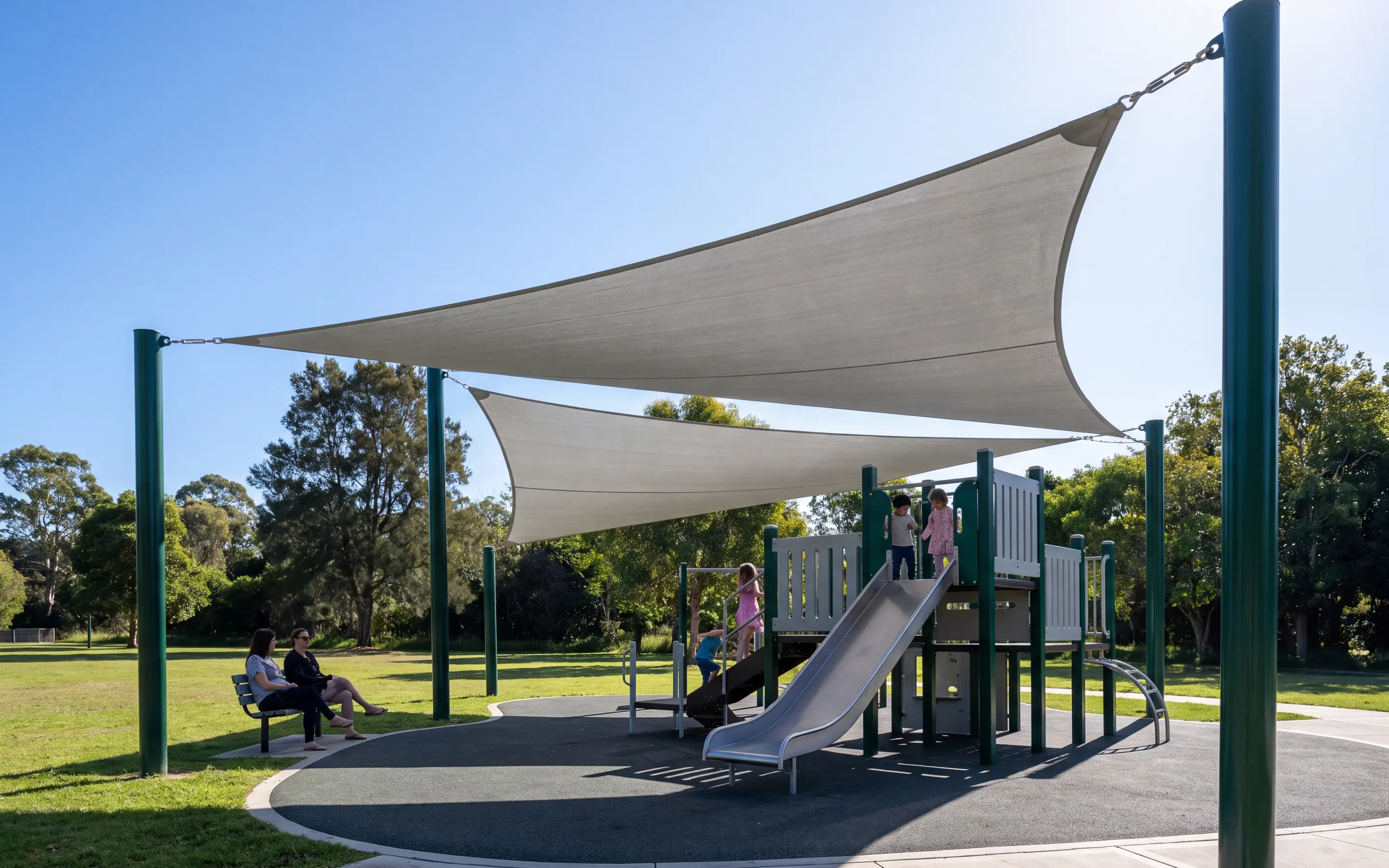
Playground Shade StructuresShade Sails, Canopies and Shade Posts for Play Areas
Playground Shade Structure RangeSails, Canopies, Cantilevers, Multi-Span Canopies and Umbrellas
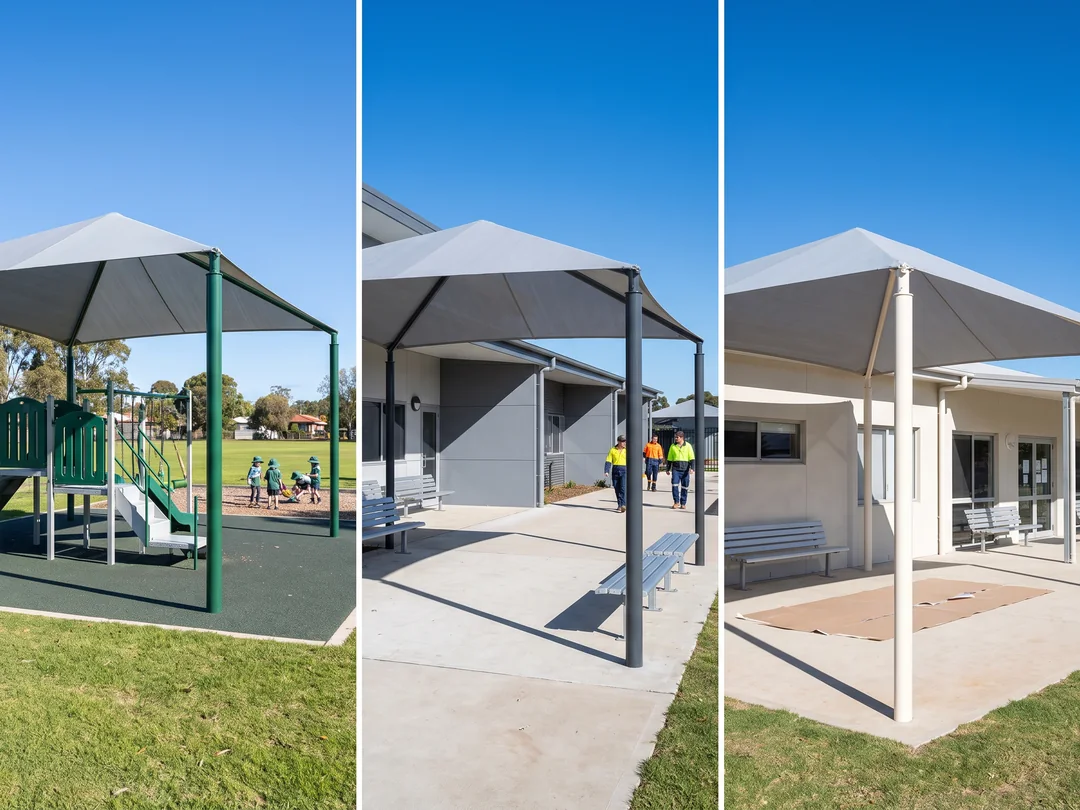
Playground shade structures from Run Playgrounds cover play structures, sand areas, seating edges and paths with tension shade sails, hip and pyramid canopies, cantilever shades, multi-span canopies, bench shades and single-post fixed umbrellas.
The shade posts and frames are made in our own steel workshop, from the same Ø114 mm galvanized, powder-coated tube as our play structure posts. The sail fabric comes from a partner factory we inspect, cut to our frame drawing.
Every shade is placed on your playground layout, and every shade post is on the footing detail drawings. All forms stand on Ø114 mm galvanized, powder-coated posts from our steel workshop, in shade range RP-09.
-
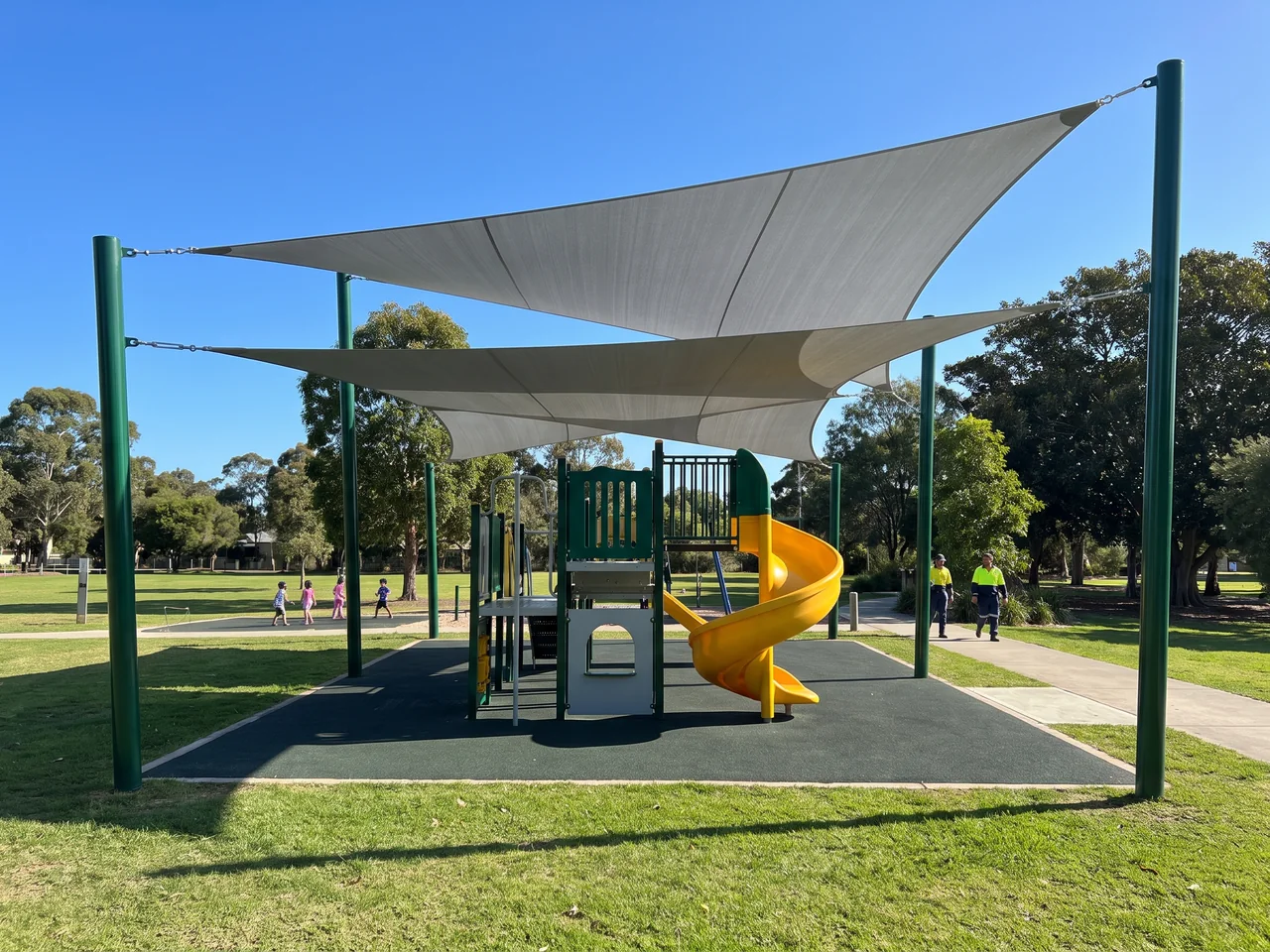 Form 01
Tension shade sails
Triangle, square and rectangle sails tensioned between posts. Two or more sails can be layered at different heights to cover an irregular play area.
Covers- Structure
- Sand
- Seating
- Path
-
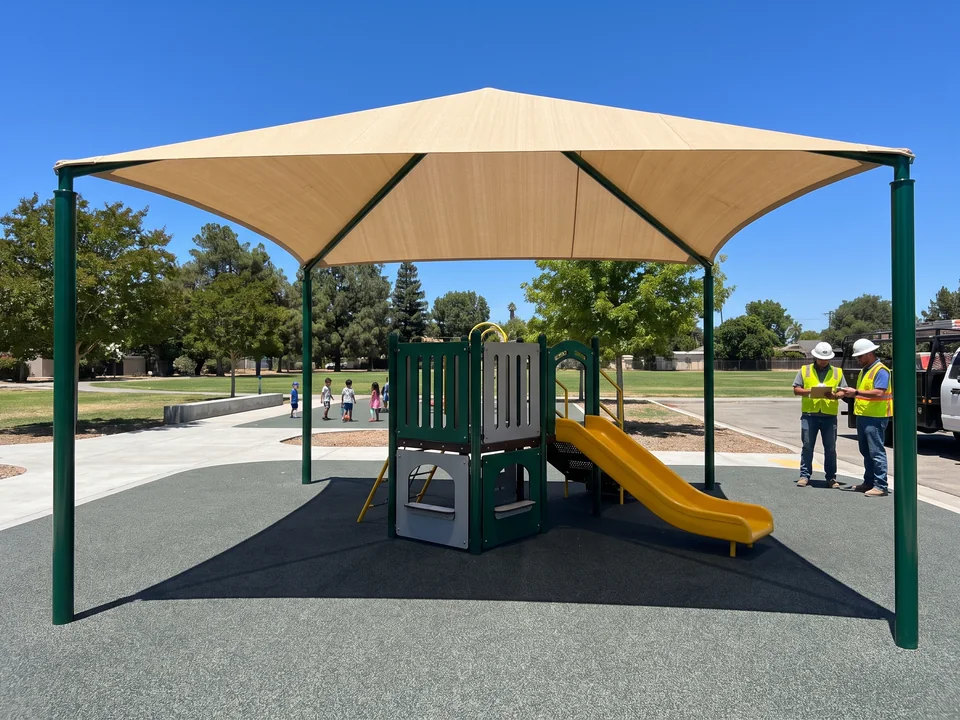 Form 02
Hip and pyramid canopies
A steel frame with a fabric roof, over a play structure or a square play zone.
Covers- Structure
- Sand
- Seating
- Path
-
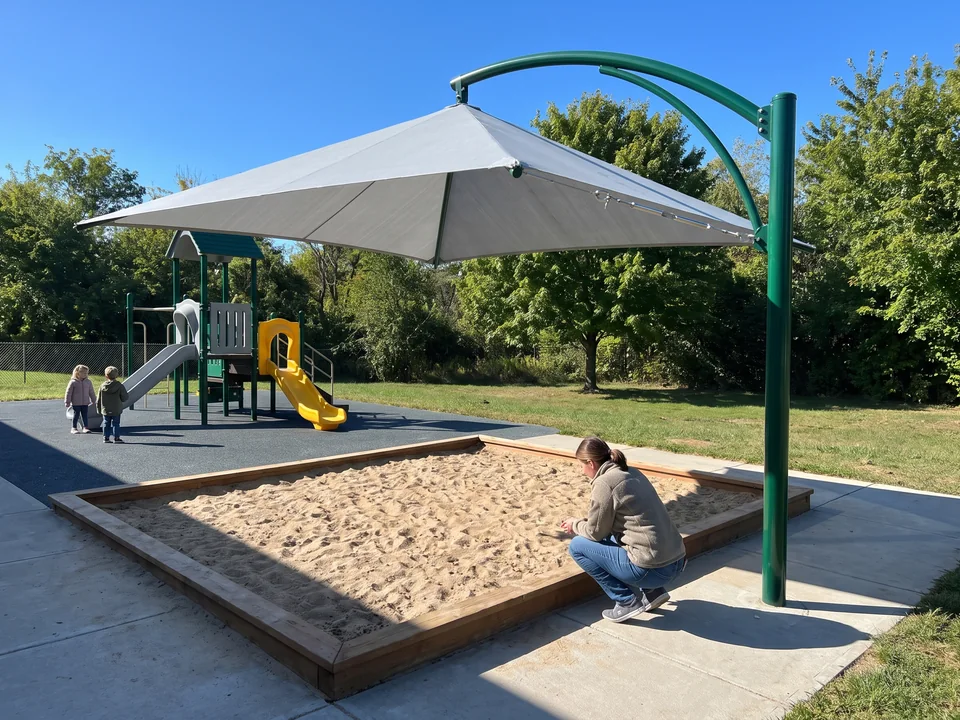 Form 03
Single-post cantilever shades
One post with the shade reaching out over a sand area or the seating edge of a play area, leaving the ground under it open.
Covers- Structure
- Sand
- Seating
- Path
-
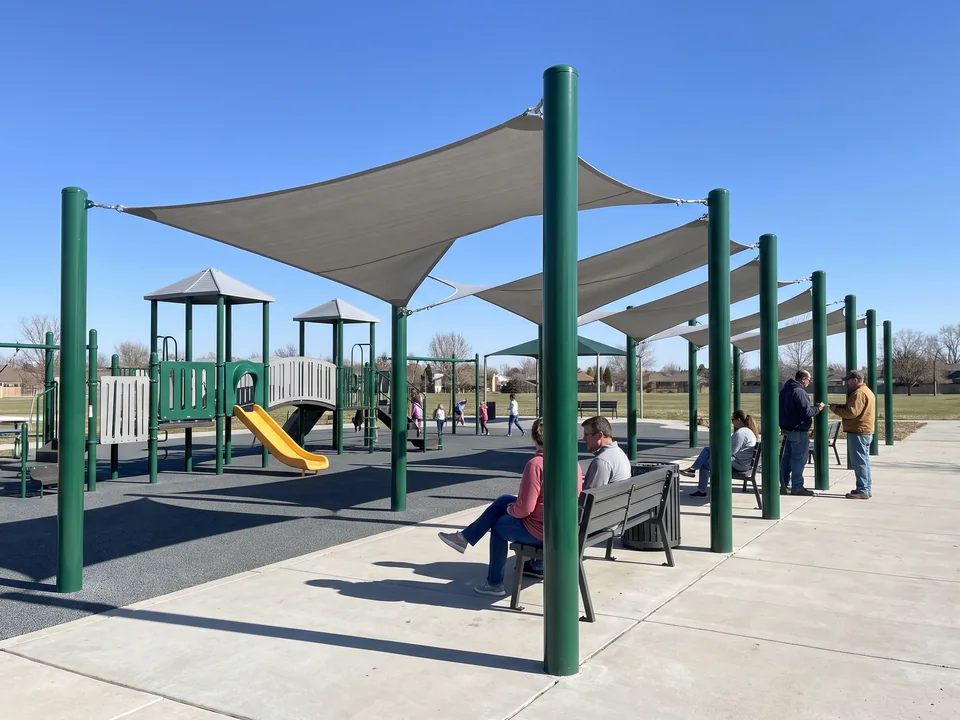 Form 04
Multi-span canopies
A row of canopy bays sharing posts, over a line of equipment, a path or a long seating edge.
Covers- Structure
- Sand
- Seating
- Path
-
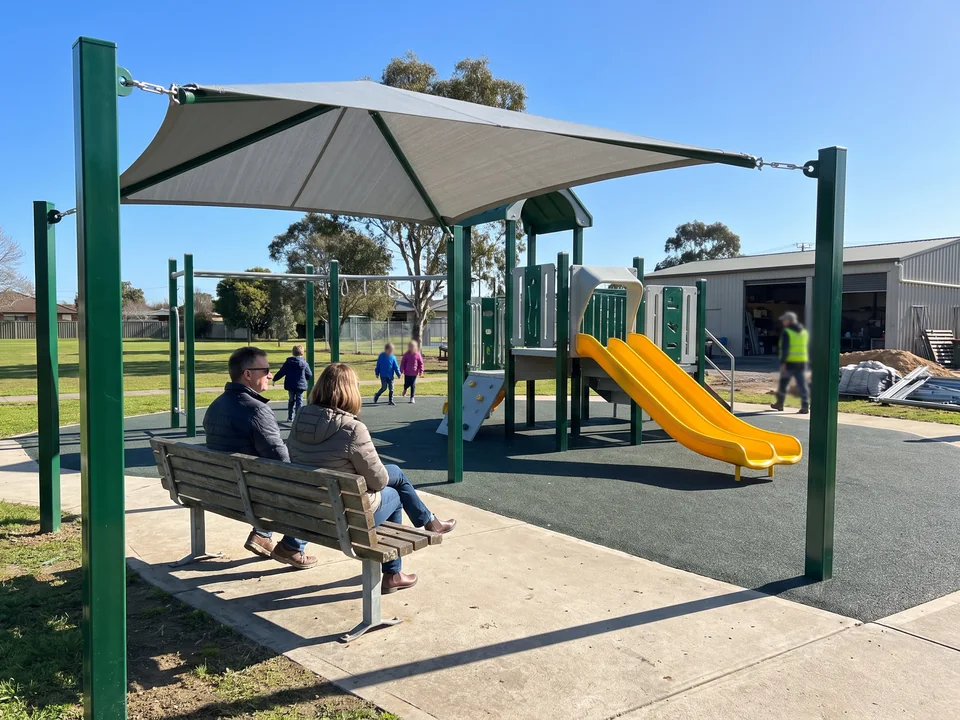 Form 05
Bench shades
Small shades over benches where parents and staff sit.
Covers- Structure
- Sand
- Seating
- Path
-
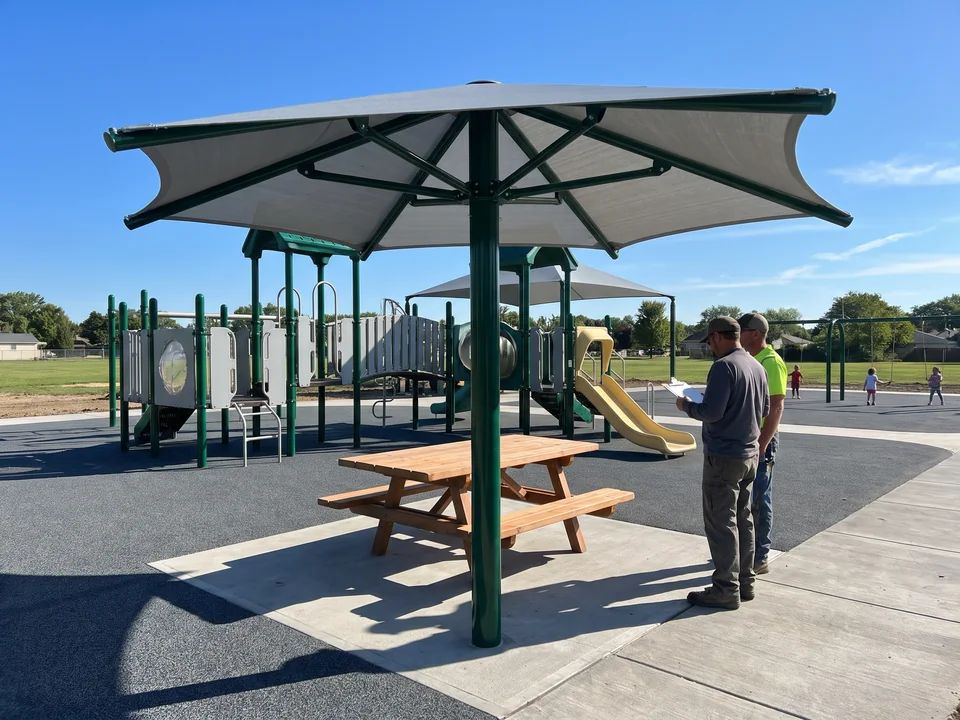 Form 06
Single-post fixed umbrellas
A fixed umbrella-form shade on one post, for small spots such as a sand table or a picnic table.
Covers- Structure
- Sand
- Seating
- Path
Fabric for every form is knitted HDPE shade cloth or PVC-coated polyester, compared further down the page.
Same Ø114 mm post · six ways to hang the fabricShade Selection by Site and CoveragePlay Structures, Sand Areas, Seating Edges and Paths
The form follows what sits underneath.
-
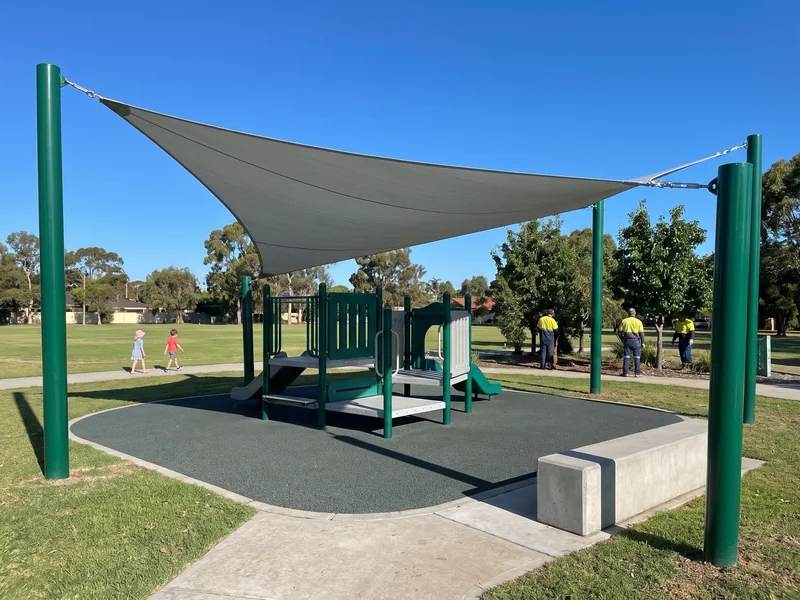
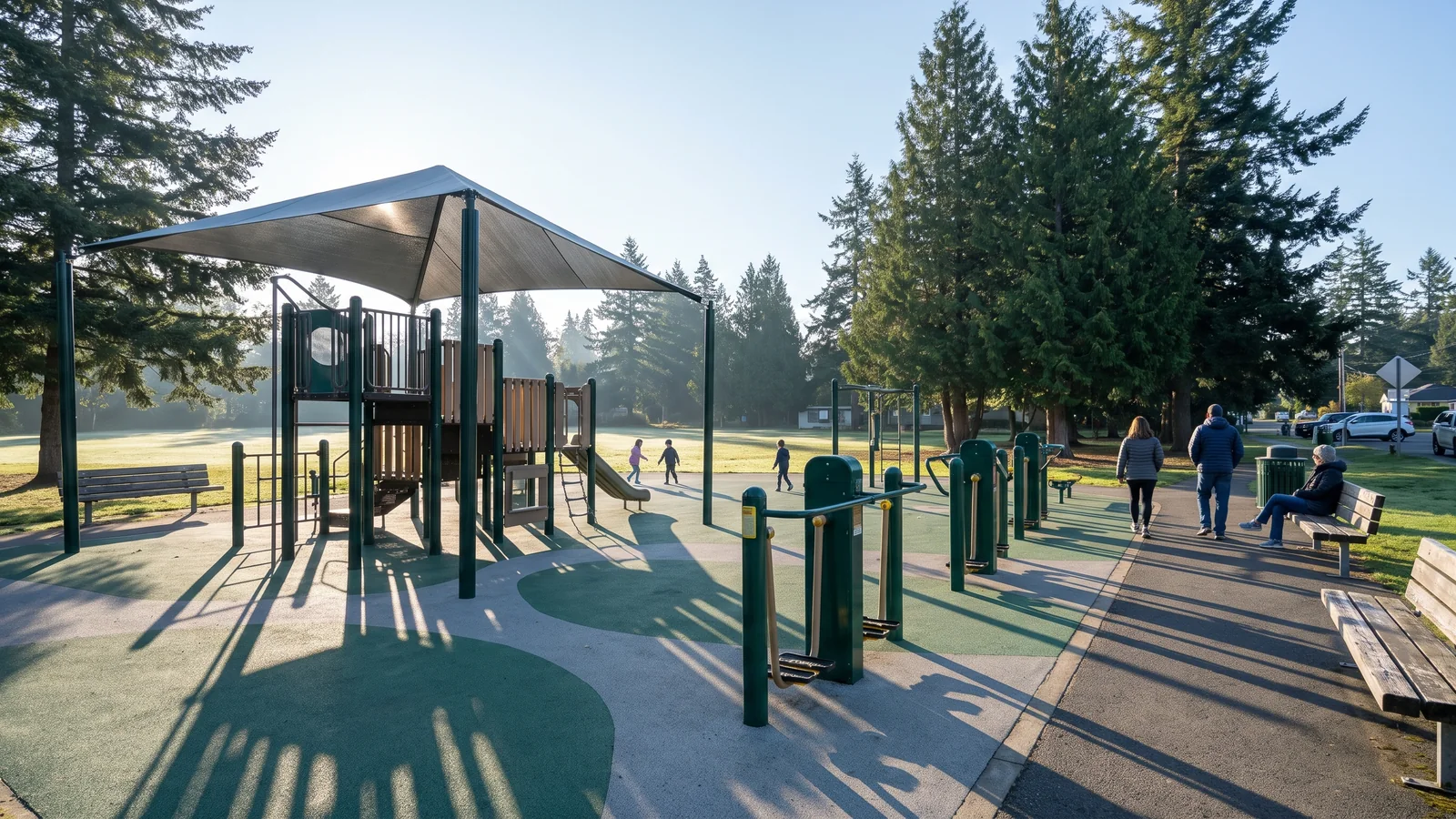
Over a play structure
Tension sails or a hip canopy, with posts set around the structure outside its use zones. Layered sails suit structures with an irregular footprint, and a hip canopy suits a compact square structure. The drawing shows the sail outline over the decks and the clearance to the highest deck or roof.
-
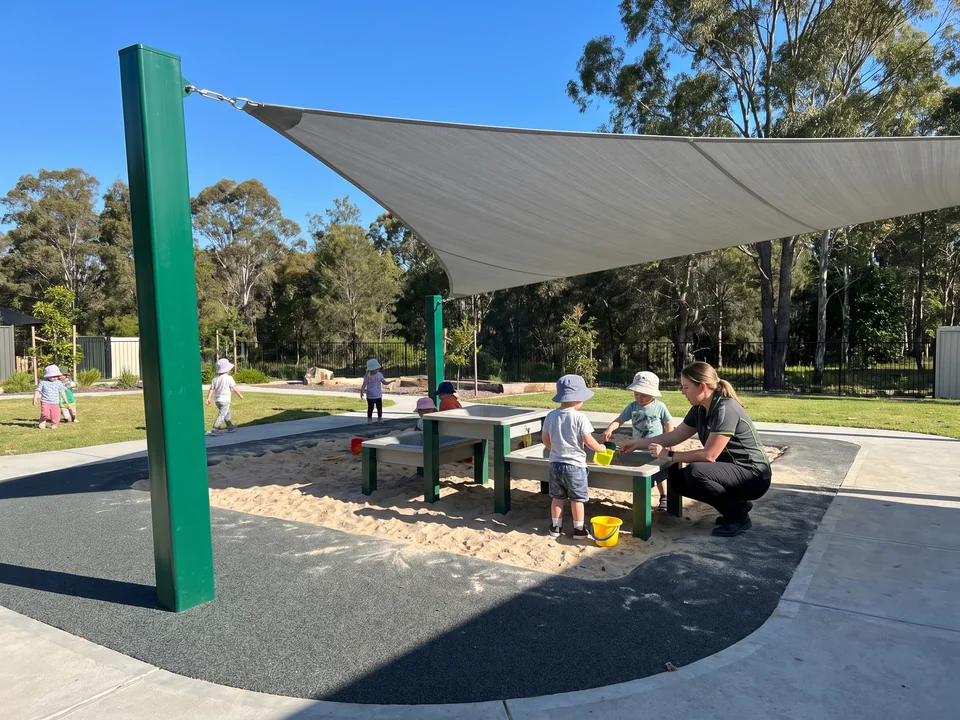
Over sand play and toddler areas
Cantilever shades and fixed umbrellas keep posts out of the play space. Preschools and daycare centers often shade the sand and water play tables and the toddler zone first; the full childcare range is on preschool and daycare playground equipment.
-
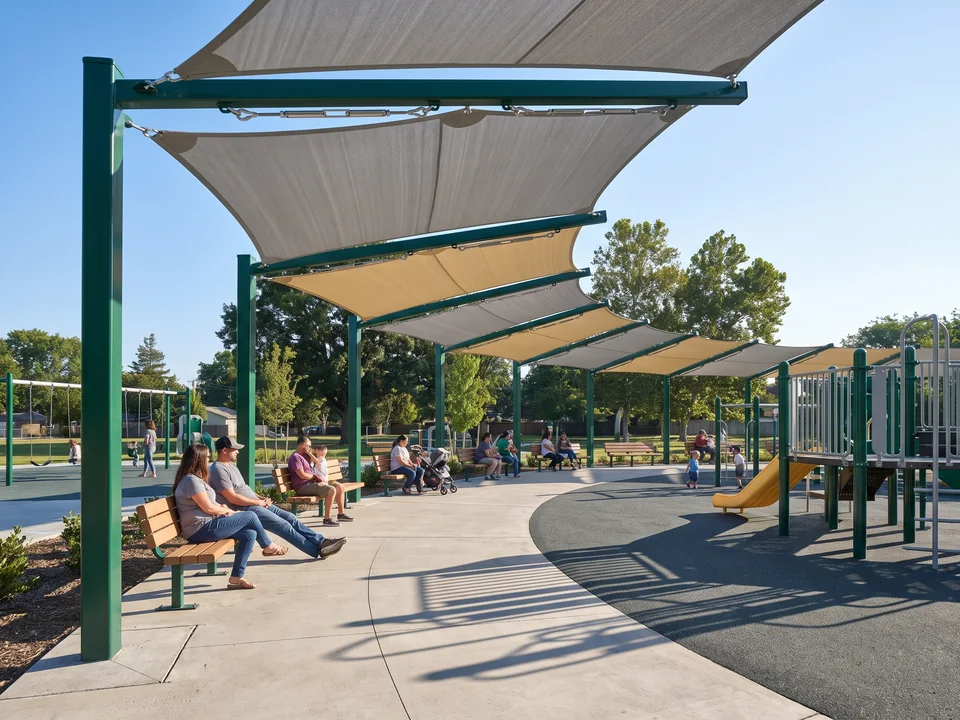
Over seating and paths
Bench shades and multi-span canopies cover the places where parents and staff watch from, and paths between zones.
-
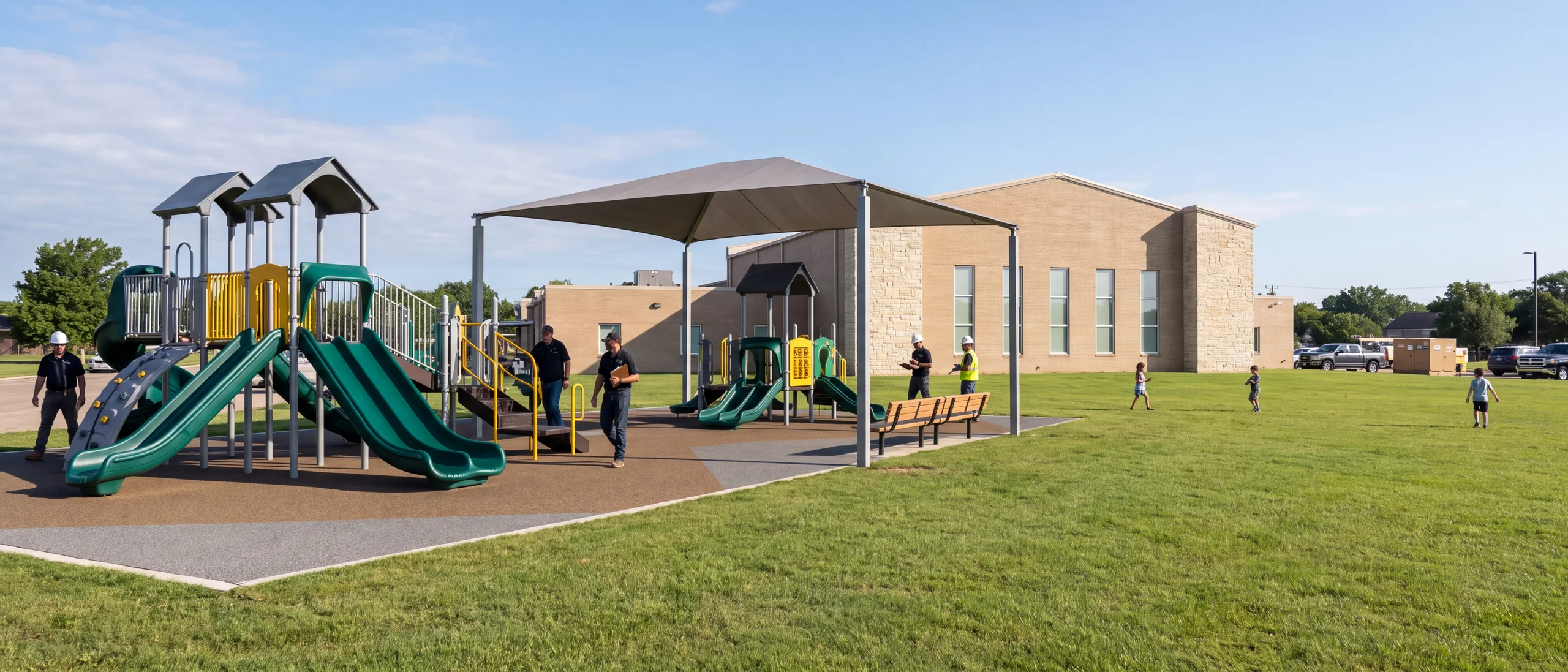
On larger sites
A park or school site often mixes forms: sails over the 2–5 and 5–12 structures, a multi-span canopy along the seating edge and bench shades by the entry. They all go on one layout, one set of footing drawings and one container plan.
Sun only → knitted HDPE shade cloth
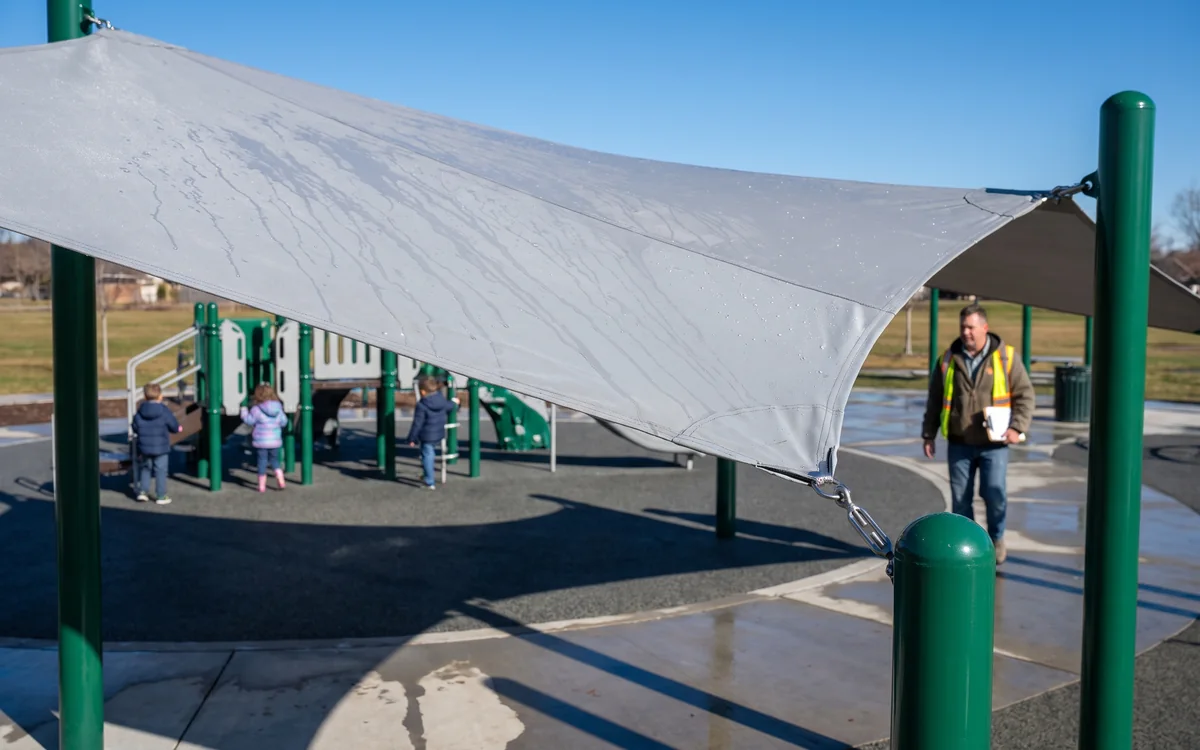
For sun only, knitted HDPE shade cloth lets rain through.
Where rain cover is needed → PVC-coated polyester
Choose PVC-coated polyester fabric. Both fabrics compared.
Shade Placement on Your Playground LayoutPost Positions, Use Zones and the North Arrow
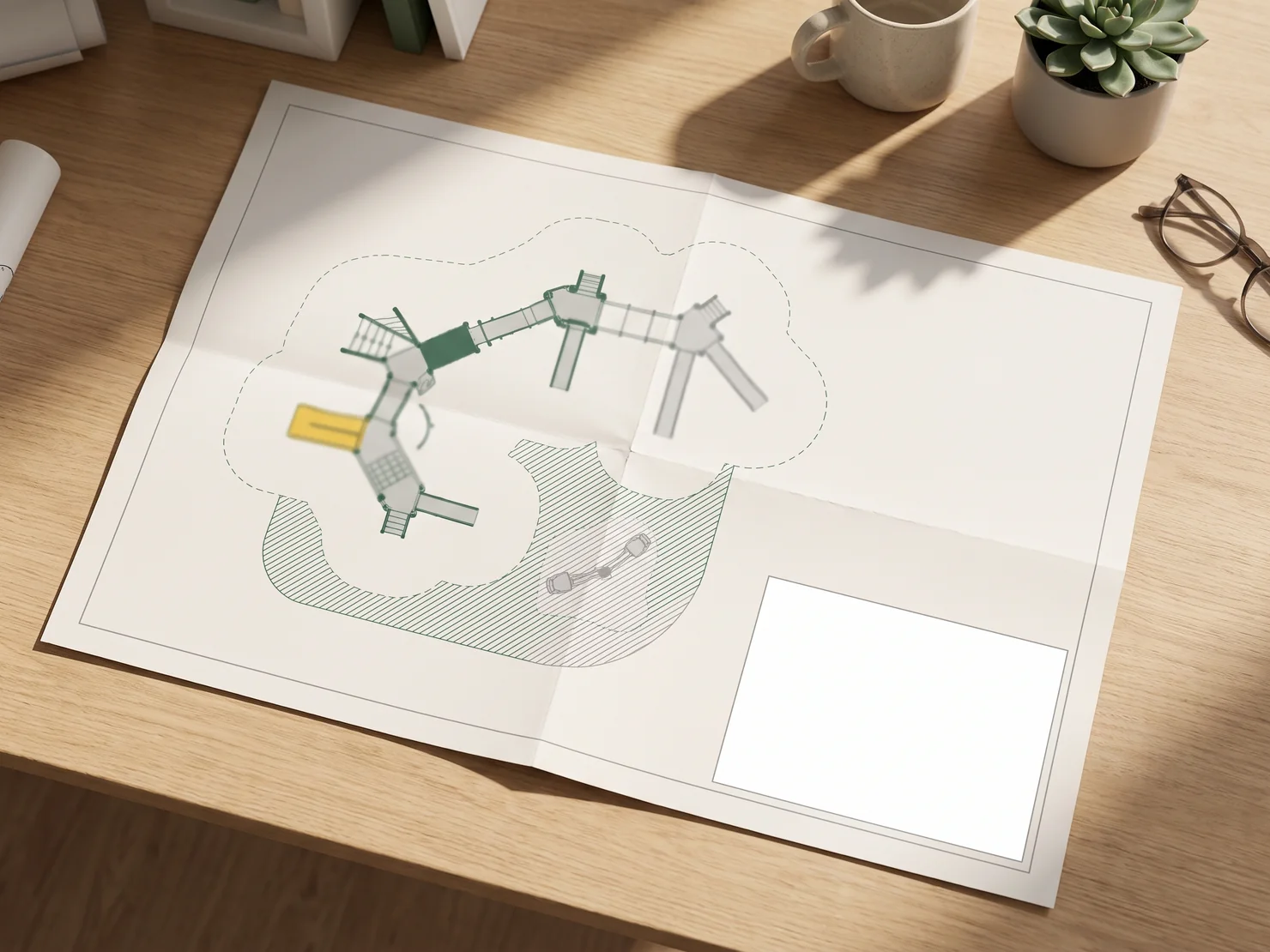
Shade is drawn by our design office on the same site layout as your play equipment, in the 2D and 3D layout returned within 3 working days of your site plan.
The design office places each shade over the structure, sand area or seating edge it covers, sets every shade post outside the use zones of the equipment around it, and marks the north arrow so you can see where the afternoon sun falls.
Shade posts get their own footings and their own H part numbers.
- Posts8 posts · outside every use zone
- H1 · sailTriangle over S1
- H2 · sail · lowerRectangle over S2
- H3 · cantileverOne post · over the sand
- FootingsOn the footing detail drawings
Shade layer · every post outside every use zone

What the drawing shows
The outline of each sail or canopy over the equipment it covers, every shade post with its
Hnumber, the use zone outline of every piece of equipment, and the north arrow. You see in one drawing what is shaded and where each post stands.Posts outside every use zone
Each shade stands on its own posts and footings and never borrows a play structure post. The design office checks every shade post against the outlines of the structures, swings, slides and spinners around it, so no post sits in a use zone or in the exit region of a slide.
If a post position clashes, the post moves or the sail shape changes on the drawing before approval.
Clearance above the equipment
The height of the sail or canopy edge above the highest deck or roof is marked on the drawing, so your reviewer can check it with the layout.
Afternoon sun
The north arrow shows which side of the play area takes the afternoon sun. The shade is set to cover that side of the structures first.
Where a stainless steel slide cannot face away from the afternoon side, it is drawn under the shade layer; slide orientation is covered on playground slides.
When the layout changes
If your landscape architect moves a structure, the shade posts are redrawn with it and the use zones are checked again.
Footings
At drawing approval every shade post goes on the footing detail drawings with its concrete footing size, next to the play structure posts. The footing drawings reach you during the 20–30 days of production, so your installer can excavate before the container arrives.
What you get
One layout with play equipment and shade together, and one footing drawing set that covers every post. A parks department or school board can review the shade at approval stage.
How the other site interfaces are drawn is on commercial playground equipment, and our layout process on playground layout design.
Shade posts and frames use the same Ø114 mm galvanized, powder-coated tubeas the play structure posts beside them.
- Shade post · Ø114 mm
- Play post · Ø114 mm
- Same coating line
Shade Posts and FramesØ114 mm Galvanized Steel, Welded Eye Plates and Footings
Shade posts and frames are made in our steel fabrication and coating workshops, on the same line as the play structure posts.
The posts and frames are cut, bent and welded in our steel workshop, hot-dip galvanized and powder coated in RAL colors, and the eye plates that take the sail corners are welded on in the same workshop.
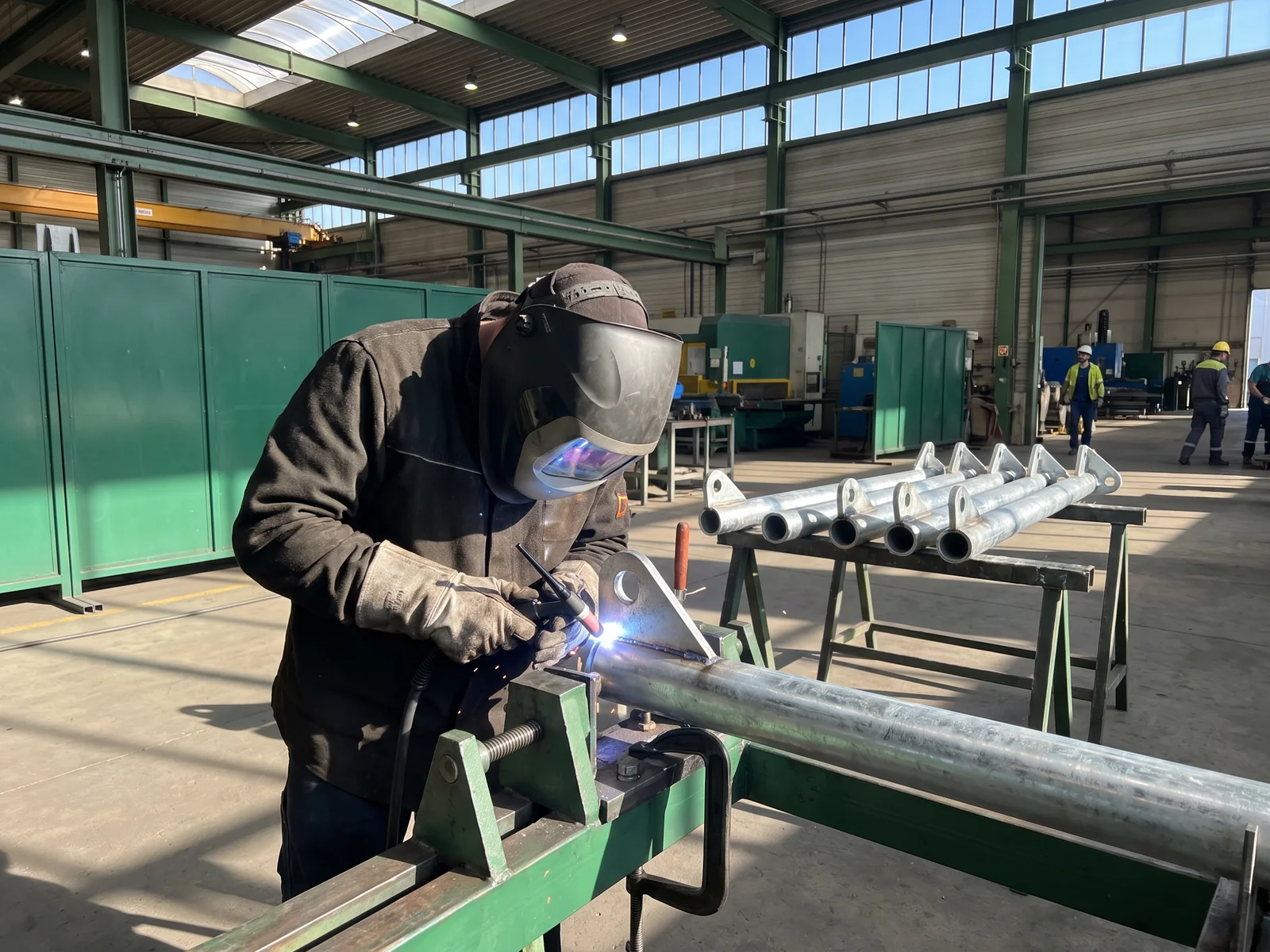
Eye plates
The eye plates that take the sail corners and the canopy fixings are welded onto the posts in our workshop, at the positions and angles set by the frame drawing. The sail's corner geometry is fixed in the factory, not on site.
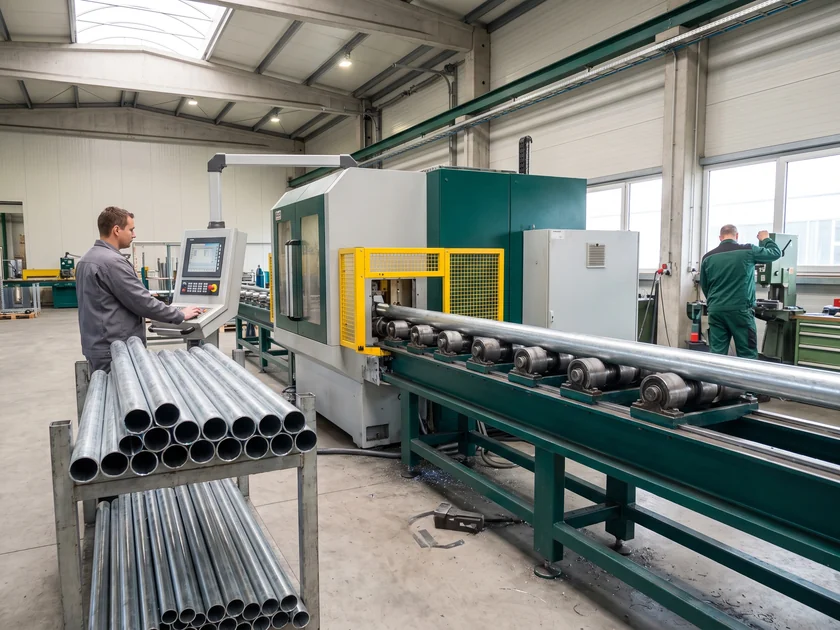
Tube, cutting and bending
Ø114 mm galvanized steel tube with a 3.0 mm wall, the same tube as our play structure posts, swing beams and fitness stations.
Posts and canopy frame members are cut on CNC tube cutting machines and bent on CNC pipe bending machines to the frame drawing; repeat joints are welded in robotic welding cells, and custom frames by hand with TIG/MIG.
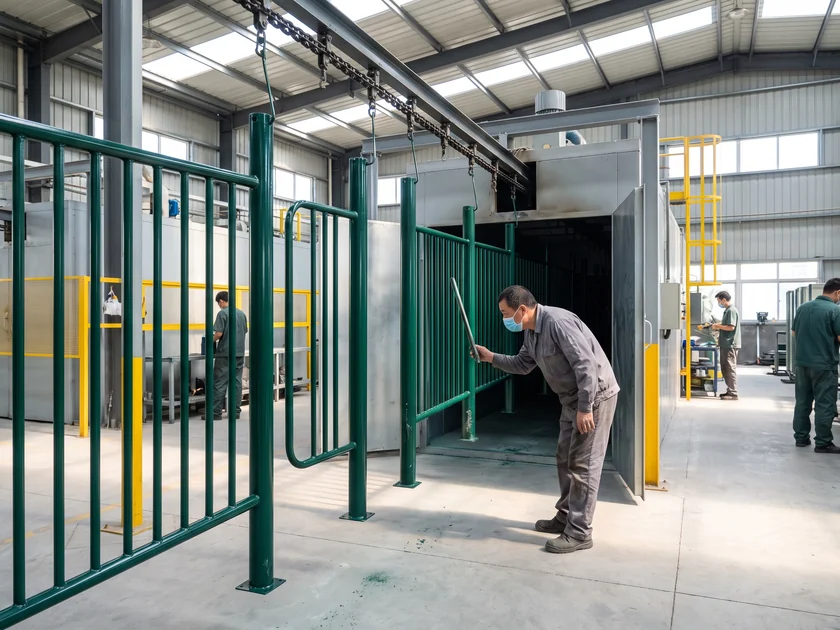
Coating
After welding, every part is at a partner plant, sand blasted, and electrostatically powder coated with polyester powder in our coating line, then cured in the oven. Frames come in RAL colors, matched to your play structures or site furniture.
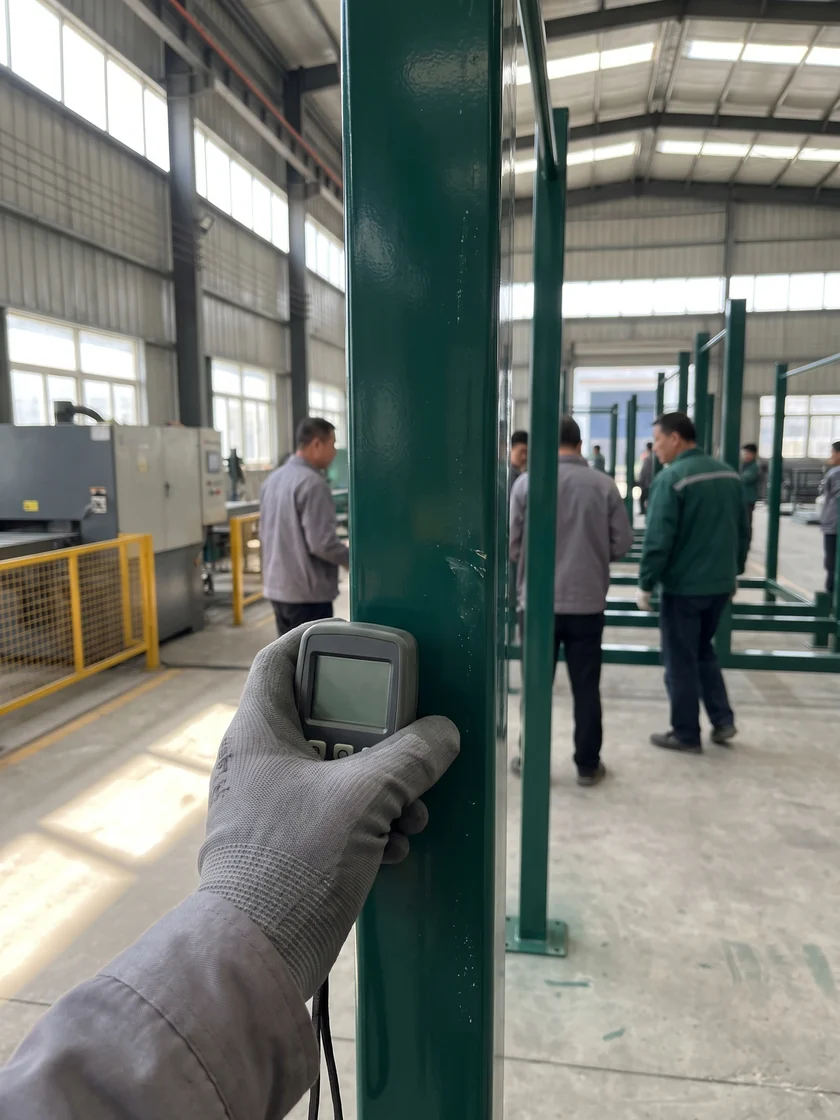
Checks
Welds and coating are checked in process, as one of our four QC checkpoints, before the frame goes to the pre-assembly yard.
Fixing
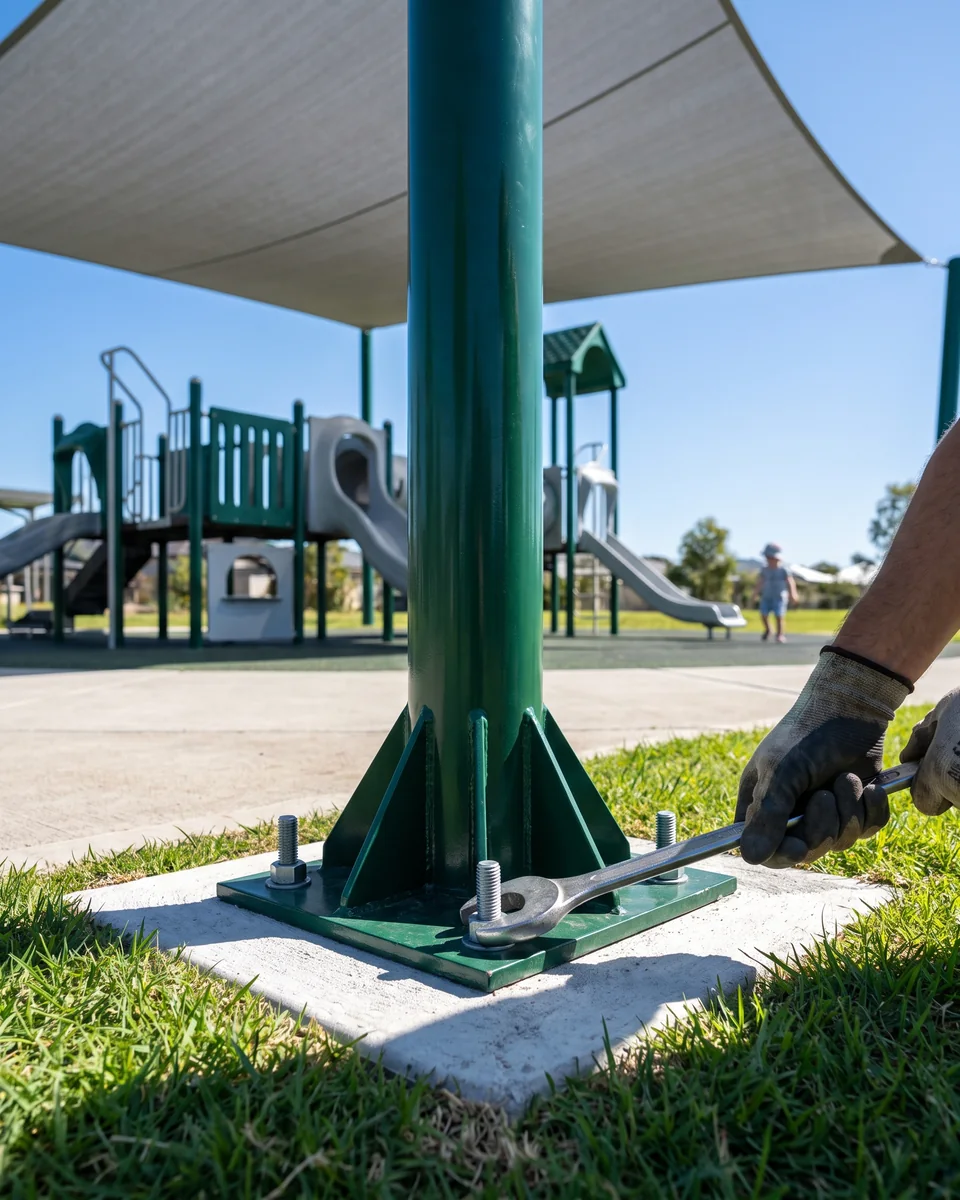
Posts are set in concrete by default, with anchor-bolt base plates as an option, both to the footing detail drawing. Anchoring hardware ships with the parts. Installation drawings and support are on playground equipment installation.
Numbering
Every post and frame member carries an H part number such as H1-003, matching the installation drawing and the packing list.
Wind load · local building code
Wind load and the local building code are checked by the buyer's structural engineer, using our frame and footing drawings.
The full coating and welding process is on playground equipment manufacturing
Tensioning Hardware and Fabric Corners304 Stainless Turnbuckles, Shackles and Reinforced Edges
- 01
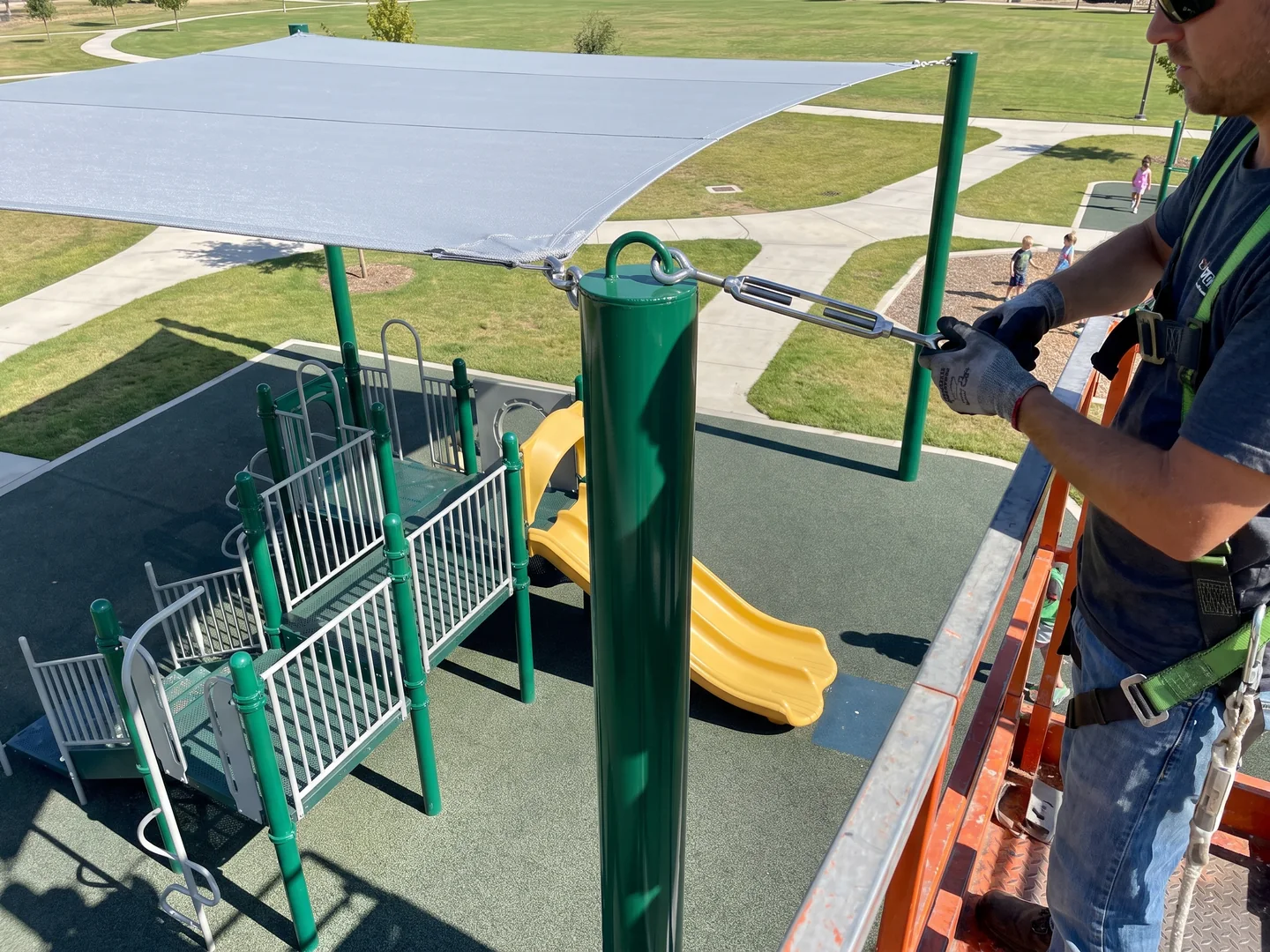
Tensioning hardware
Sails are tensioned with 304 stainless steel and shackles fixed to the welded eye plates. The hardware sits at the top of the posts, out of reach from the ground.
The turnbuckles are locked once tensioned, in line with the tamper-resistant 304 fasteners used across our play structures.
- 02
Fabric edges
Sail edges are reinforced with webbing or stainless steel wire rope, so the tension runs along the edge to the corners.
- 03
Fabric corners
Each corner carries a stainless steel corner plate or that connects to the shackle and turnbuckle.
- 04
Numbered corners
Each sail corner is numbered to match its post, so the sail goes back on the same way after it has been taken down.
- 05
What comes in the box
Turnbuckles, shackles and fixings are listed by part number with the frame parts, and the security bits for the tamper-resistant fasteners come in the spare kit.
Shade Fabric ComparisonKnitted HDPE Shade Cloth vs PVC-Coated Polyester
Both fabrics are made by a partner factory to our frame drawing and inspected by our QC before loading.
| Two fabrics | 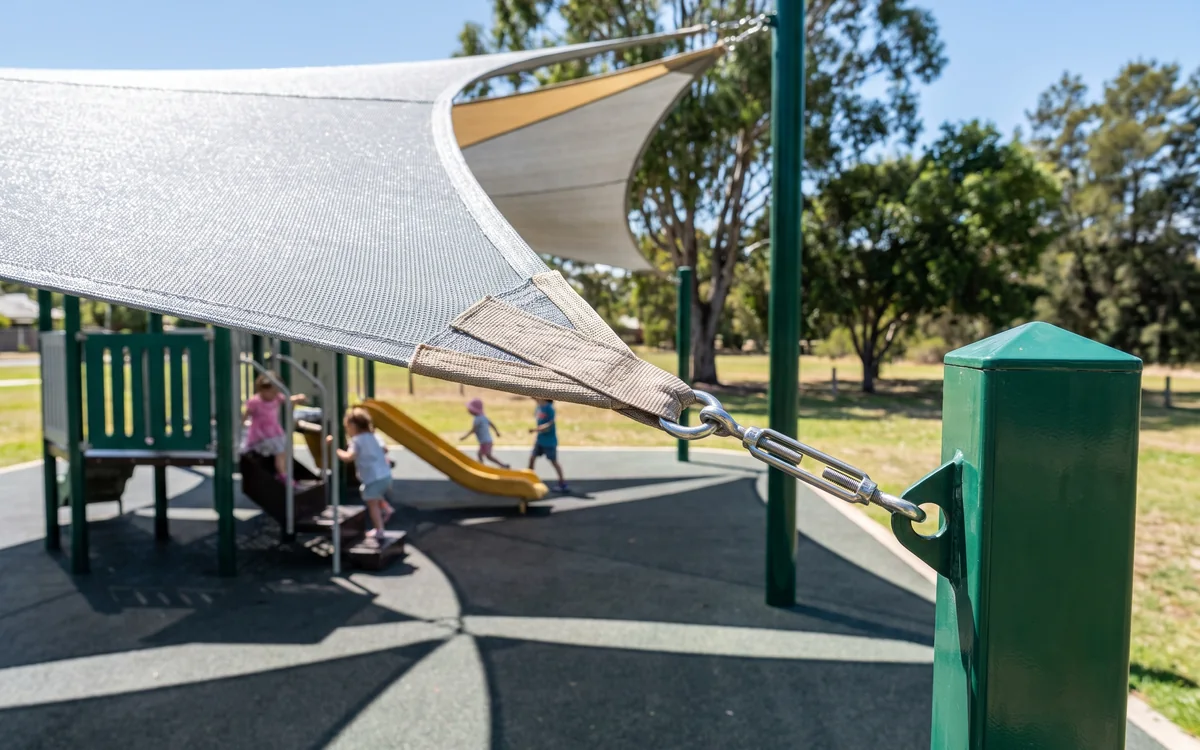 |
 |
|---|---|---|
| Structure | knitted, breathable | coated, closed surface |
| Rain | lets rain through | waterproof |
| Choose it for | sun cover over play areas, sand areas and seating | play areas and seating that also need rain cover |
| Forms | sails, canopies, cantilevers, umbrellasSame for both | |
| Colors | partner color cardSame for both | |
| Edges and corners | webbing or stainless wire rope edge, stainless corner plates or D-ringsSame for both | |
| Replacement | remade by part number to the size recordSame for both | |
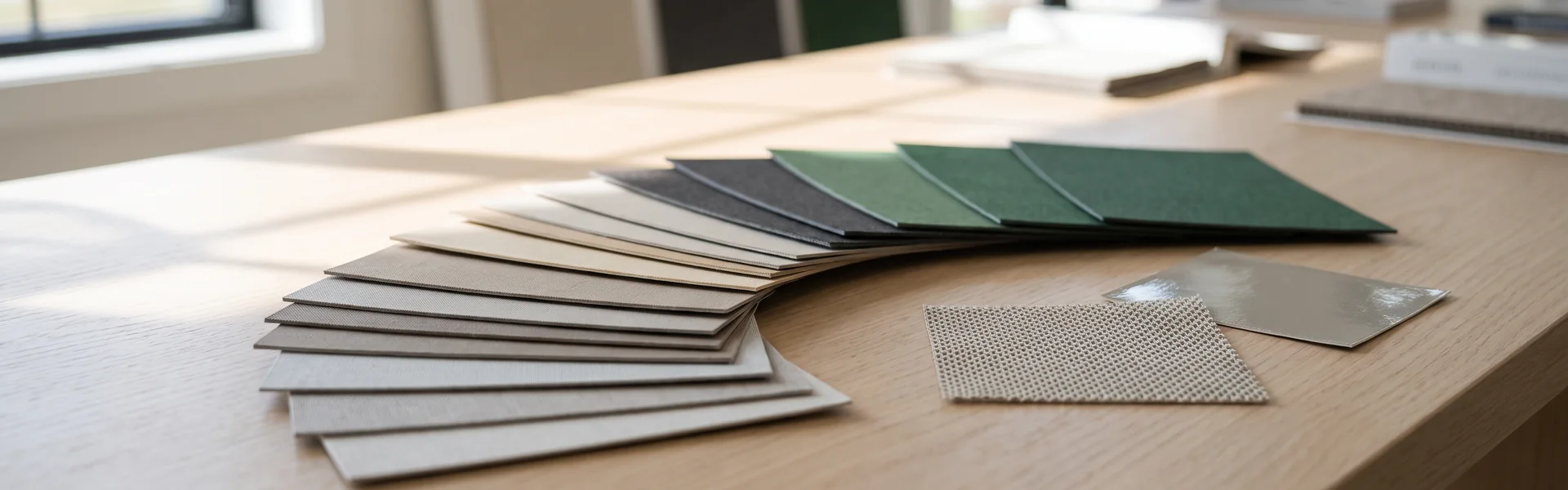
Fabric color is chosen from the partner factory's color card and confirmed before production.
Colors from the partner color card · confirmed before productionFrame Trial Assembly and Fabric Size Check Before Packing
Shade frames are trial-assembled in our pre-assembly yard with your outdoor order, alongside the play structures they will stand beside, and the fabric is checked for size against the frame drawing before loading.
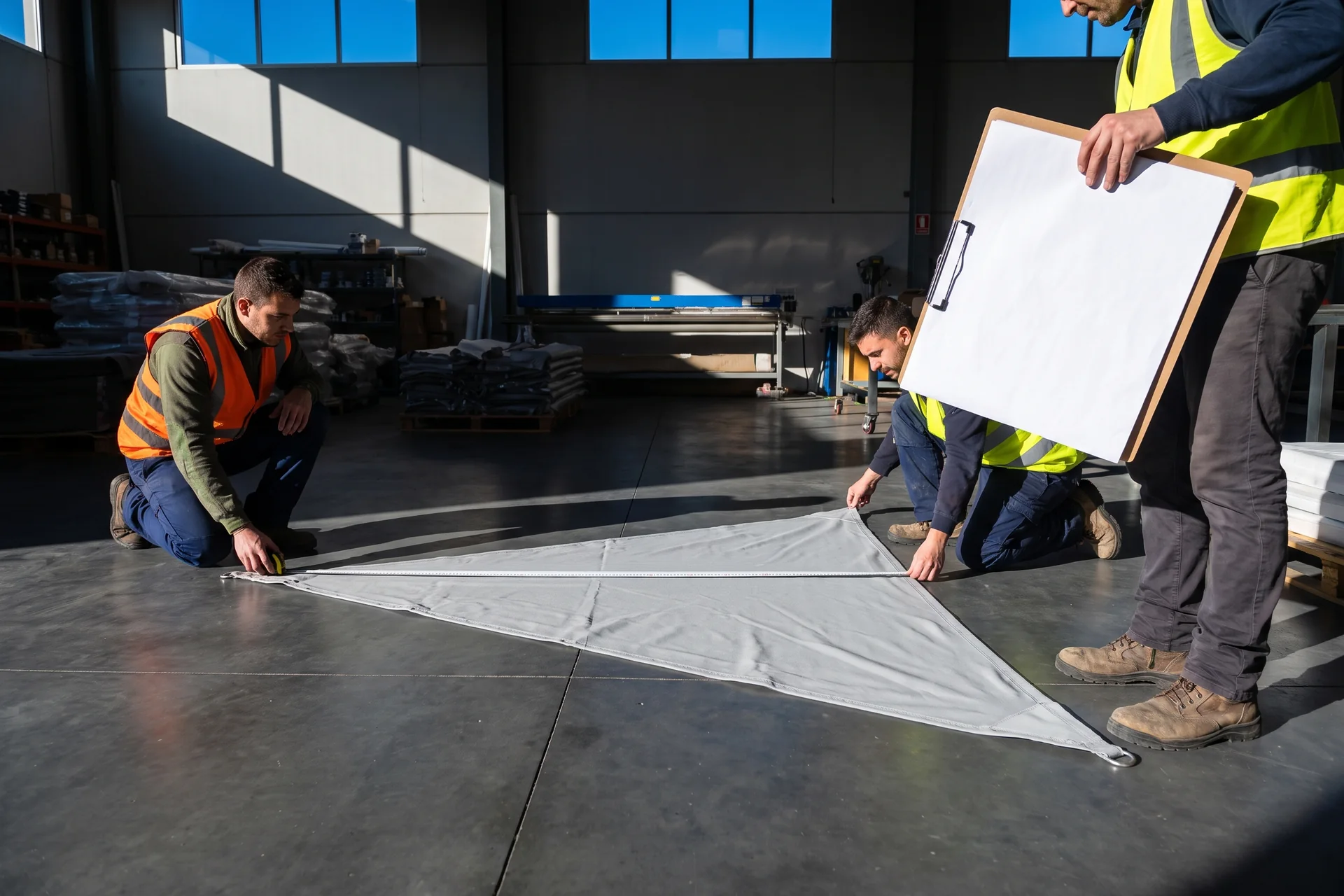
- Corner to corner
- Edge reinforcement
- Corner plates or D-rings
- Seams
- Color vs approved
Fabric size check
The sail fabric arrives from the partner factory and our QC checks it against the frame drawing: the corner-to-corner dimensions of each sail, the edge reinforcement, the corner plates or D-rings, the seams and the color against your approved color.
A sail that does not match is returned to the partner factory and corrected before loading.
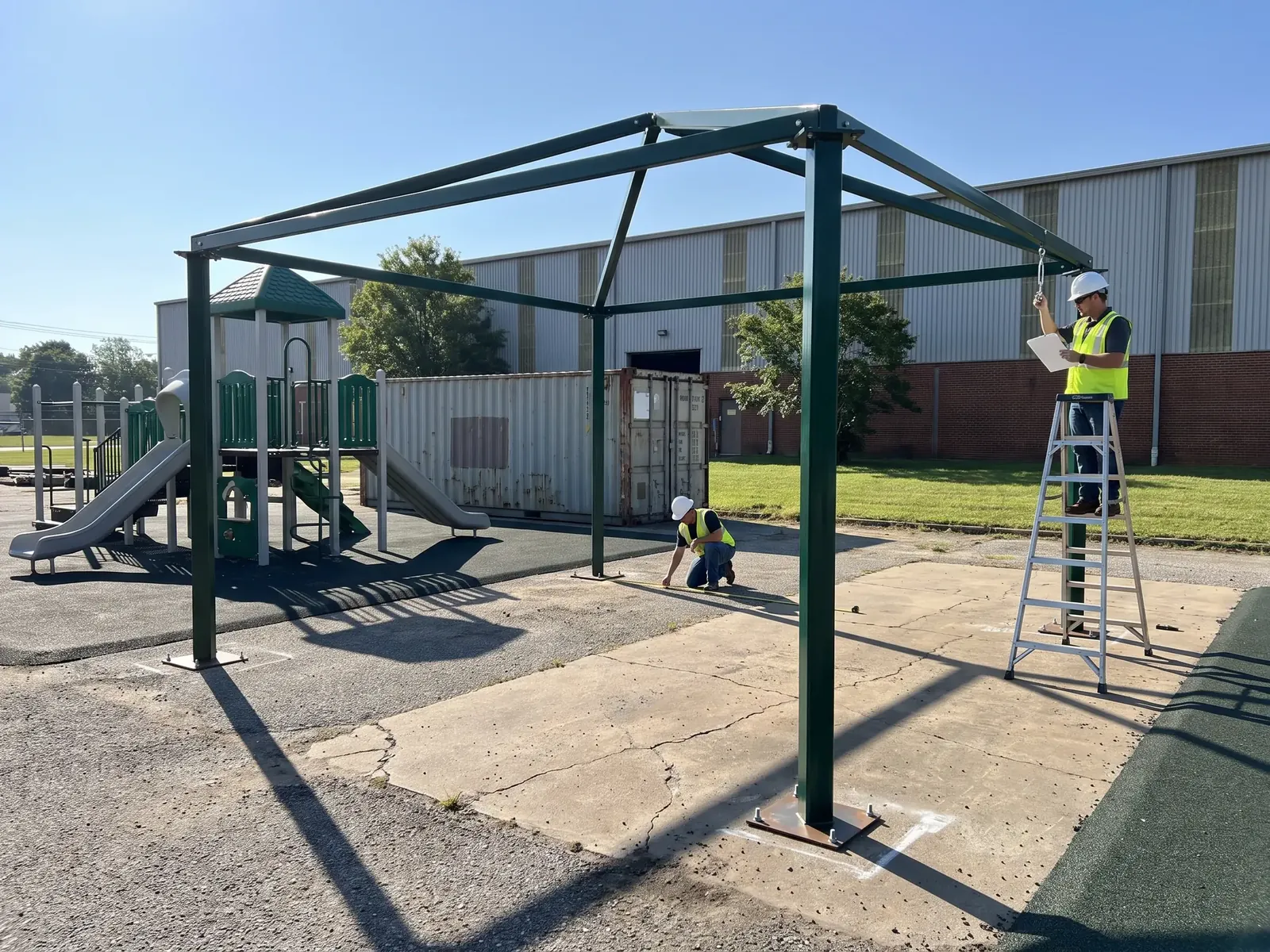
Frame trial assembly
The yard team stands up the posts and frame members to the installation drawing and checks every connection: post to frame, frame to canopy fixings, and the position of every eye plate against the frame drawing.
A part that does not fit is corrected in the factory and refitted before disassembly. The QC team signs off before the frame is taken apart.
Numbering and packing
After sign-off the frame is disassembled, each part labeled with its H number at the numbering station, and packed to the packing list.
- Fabric · partner factory
- Frames · our steel workshop
- Play structures · our workshops
One loading date, one container plan
The partner factory is scheduled to the same loading date as our workshops, so the fabric, frames and play structures ship on one container plan. Production is 20–30 days after drawing approval. How the project runs from drawing to container is on how we build playgrounds.
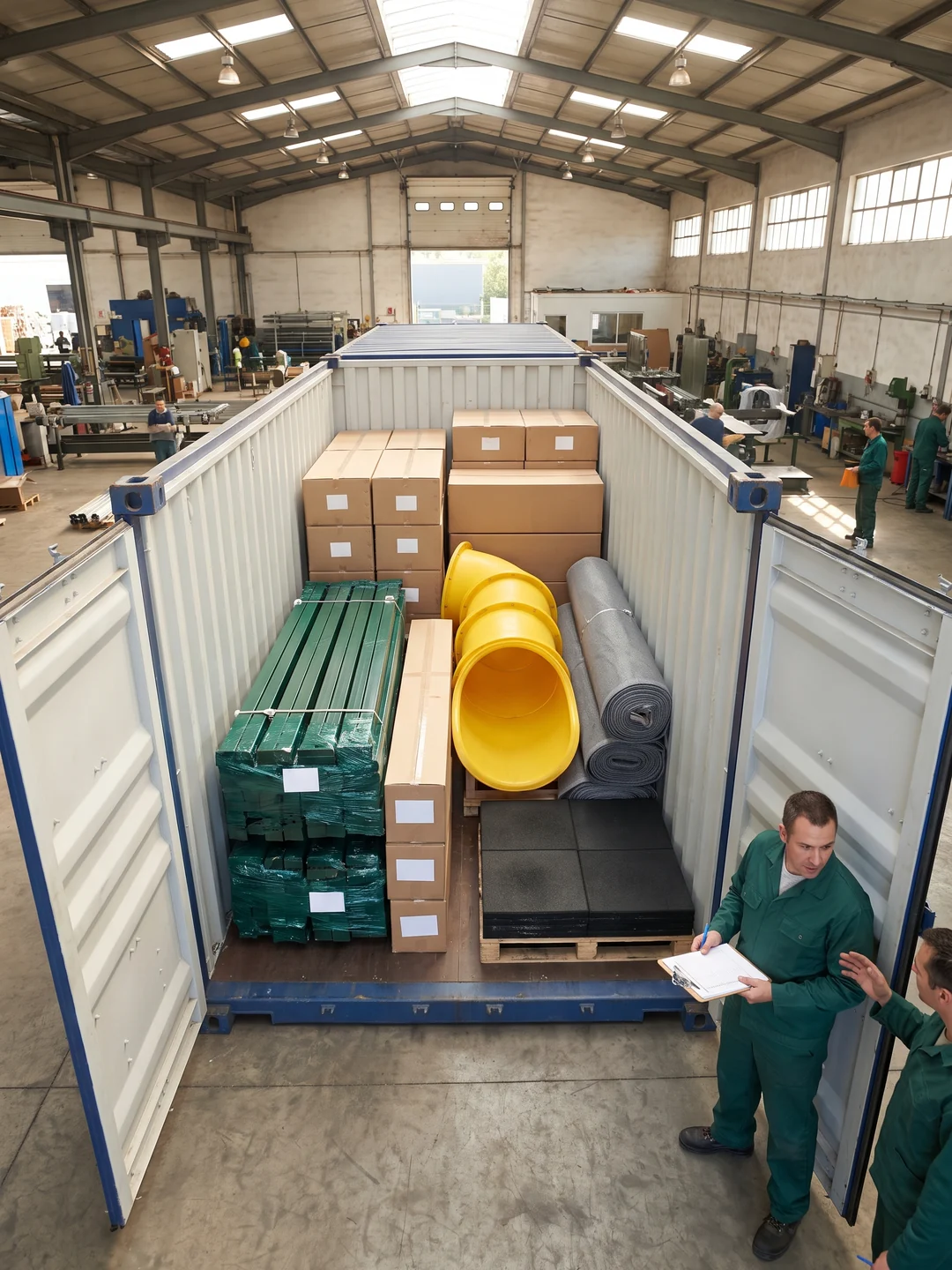
What you receive
Pre-assembly photos and video
of your order before packing
Frame parts numbered
to the drawing
Sails with numbered corners
each corner to its post
A packing list
you tick line by line at unpacking
Send your site plan and mark the structures, sand areas or seating you want shaded.
Drawn onto your layout · 3 working days Send Your Site PlanSeasonal Take-Down and Replacement FabricNumbered Corners and Size Records
The fabric is designed to be taken down and refitted by site staff while the frame stays in place. Staff release the locked turnbuckles, unhook the shackles and store the sail; the numbered corners show which corner goes back to which post.
When a sail needs replacing, it is remade to the size record in your project file.
- 01
Release the locked turnbuckles
- 02
Unhook the shackles
- 03
Store the sail
- 04
Refit · each corner to its post
When to take the fabric down, for a season or ahead of a storm, is decided by the owner's maintenance plan and the owner's engineer. Take-down and refitting steps are in the installation and maintenance guide that comes with your drawings.
Size record in your project file
The final dimensions and corner positions of every sail are kept in your project file under its H part number.
Ordering a replacement sail
Send a photo of the shade and the H part number from your packing list. We confirm it against your project's part list and remake the sail to the size record, so nobody has to measure the frame again on site.
Small parts such as turnbuckles and shackles go by courier. Larger sails ship with your next shipment.
- Photo + H number
- Confirmed against your part list
- Remade to the size record
- Courier · small parts / next shipment · larger sails
Adding shade later
Shades added in a second phase are drawn on the same layout, with new posts added to the footing drawings and new H numbers in the same project file.
Dealers and park departments
A dealer can reorder sails for several sites from the part numbers on each site's packing list. A parks department can keep a spare sail for a busy site under the same part number.
Freestanding Shade vs Structure RoofsWhat Each One Covers
Play structures can also carry their own roofs. These are a different item from a freestanding shade.
| Item | 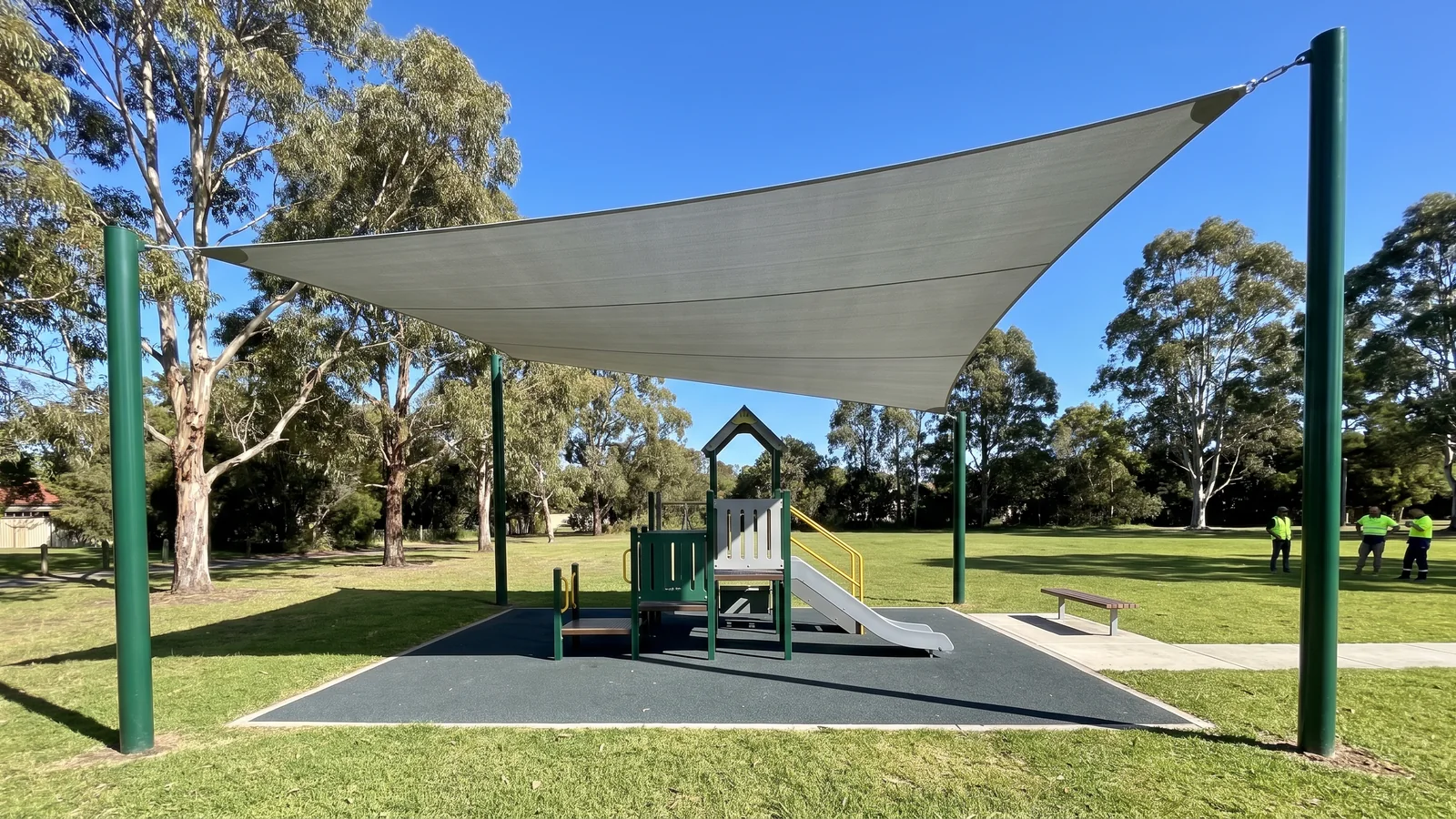 Freestanding shade structure | 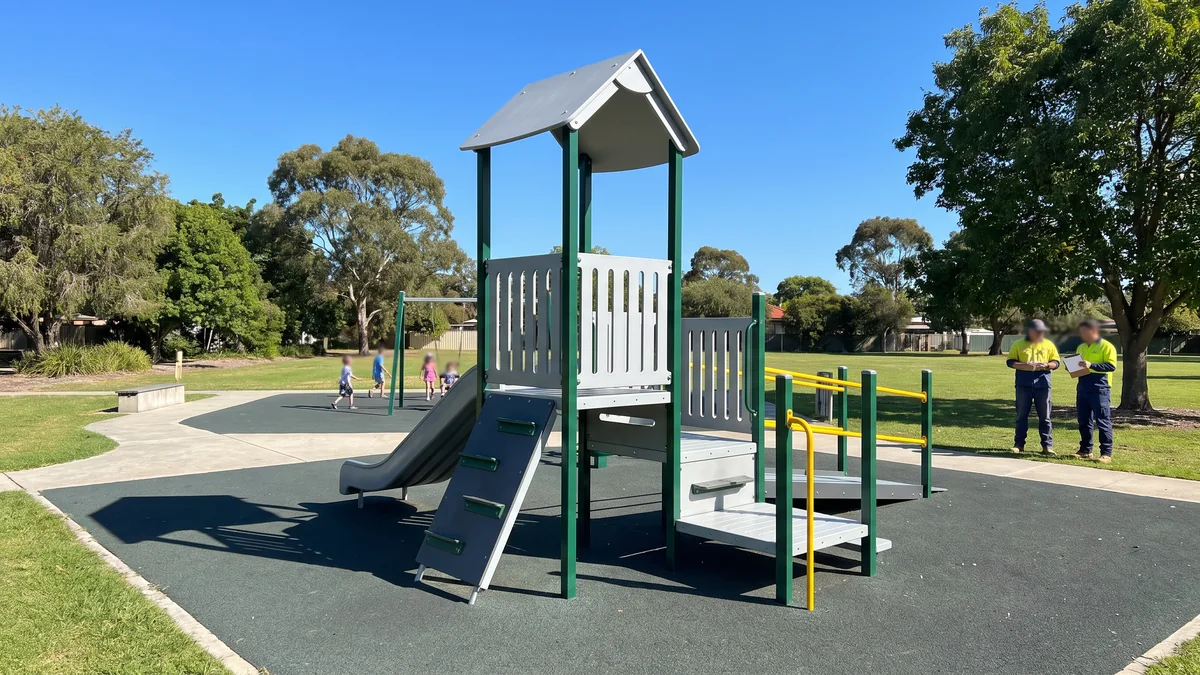 Structure roof |
|---|---|---|
| What it is | sail or canopy on its own posts and footings | rotomolded or HDPE roof on top of a tower or deck |
| Made by | posts and frames in our steel workshop; fabric partner-built | our rotomolding or panel & CNC workshop |
| Covers | the structure, surrounding play space, sand areas, seating and paths | one tower or deck |
| Posts | its own, outside every use zone | the structure's own posts |
| Warranty | steel frames 10 years; fabric remade by part number | 5 years |
Many sites use both: roofs on the towers, and sails over the wider play area. The full outdoor range, roofs included, is on commercial playground equipment
Shade OptionsRAL Frame Colors, Fabric Colors and Dealer Signage
 Frame color
RAL frame colors
Posts and frames powder coated in RAL colors, matched to the play structures or the site's architecture.
- Fabric color
Fabric color
Chosen from the partner factory's color card and confirmed before production.
- Fabric type
Fabric type
Knitted HDPE shade cloth or PVC-coated polyester, per shade.
 Fixing
Concrete or base plate
Posts in concrete, or anchor-bolt base plates.
 Dealer branding
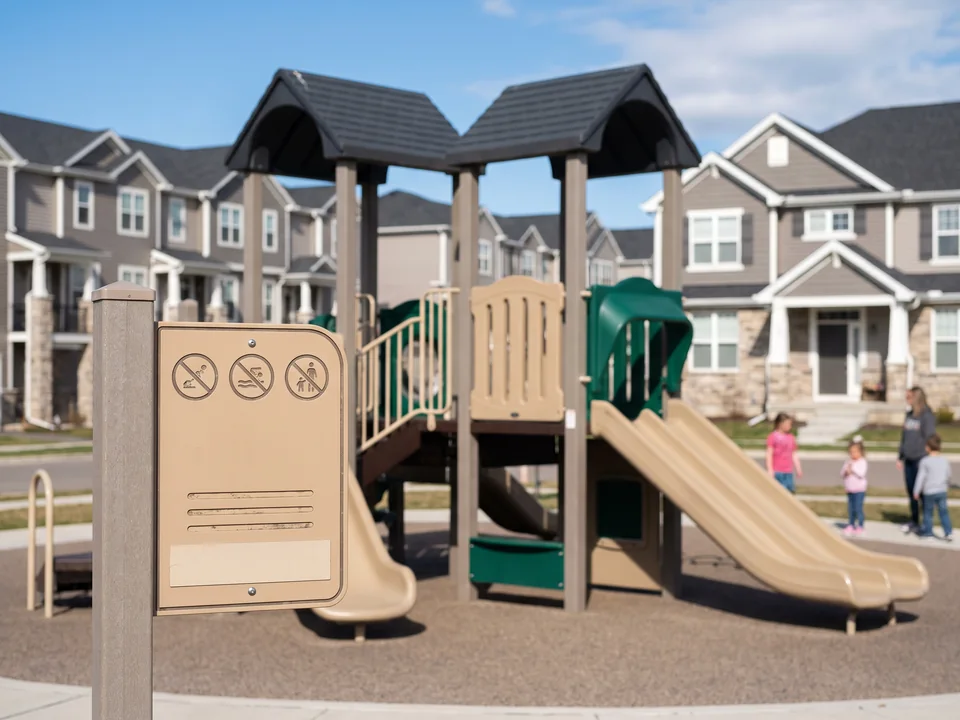
Logo on the sign
A dealer logo goes on the site signage, not on the fabric. Layouts and renders go out under your brand; see wholesale playground equipment.
Logo on the sign · not on the fabric
Warranty on Shade Structures10-Year Steel Frames, Fabric Remade by Part Number
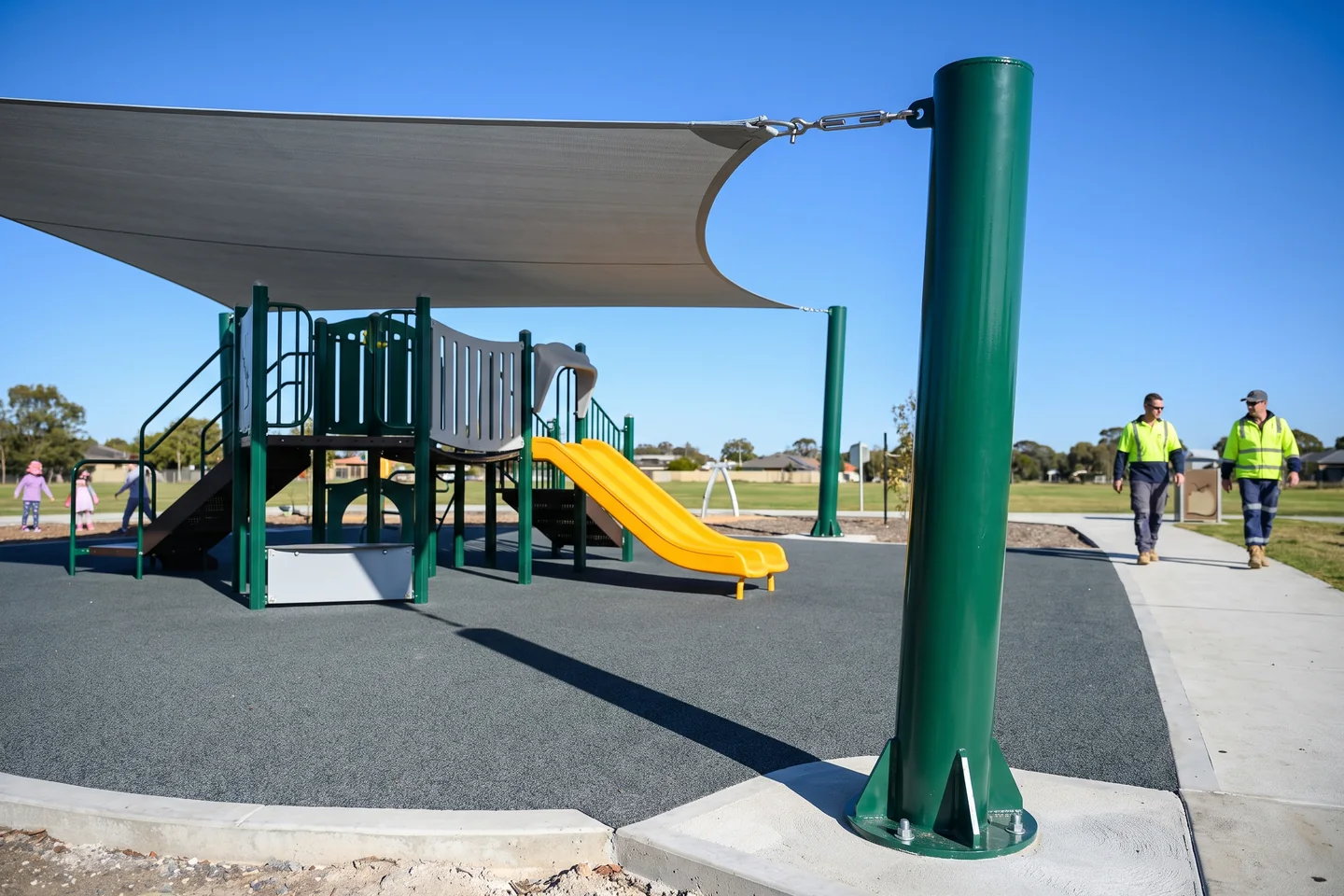
Steel posts and frames: 10 years, the same term as the steel of our play structures.
A replaceable wear part
Fabric is a replaceable wear part. Each sail is remade by its H part number to the size record in your project file.
Photo, part number, reply
For a frame claim, send a photo of the part in place with its H number. We reply within 24 hours on business days and ship the part made to the same number.
- Photo with its H number
- Reply within 24 hours on business days
- Part made to the same number
How warranty and shade lines appear in a quotation is on playground equipment cost. Our workshops and partner-factory program are on about us, and design standards for the equipment under the shade on playground safety standards.
What to Send for a Playground Shade Structure Quotation
- Site plan with dimensions, and the equipment already on site or planned
- What to shade: play structures, sand areas, seating edges, paths
- Shade forms wanted, or let the design office propose them
- Fabric: knitted HDPE shade cloth, or PVC-coated polyester for rain cover
- Ground at each post: soil or existing slab
- RAL frame color and fabric color
- Whether your structural engineer needs our frame and footing drawings for the wind load check
- For replacement sails: a photo and the
Hpart number from your packing list
Send to Anna · WhatsApp +86 177 0272 7677